Automation and AI
Automation that keeps the judgment calls with a person
I automate a step only after I’ve done it by hand and timed it, and the judgment calls stay with a person. That took site research from about 8 hours a day to 2–3 at Novum, and replies at Matchworks from 27.1 minutes to 5.6.
Where I’ve automated the slow step
3 employers, oldest first
2021–2024
Novum · Head of Link Building, then Operations Manager
The slow step was site research, so in September 2024 I built a Python and OpenAI tool that pre-qualified sites overnight.
8 h → 2–3 h
- A Google Sheets ledger of every domain we pitched, about 11,500 in its first year from March 2022, stopped the team pitching the same site twice
- Google Sheets and Apps Script for the plumbing
A day of site research
An assistant picked the 300–500 sites worth pitching out of 1,000–3,000.
2024–2025
Genius · Head of Recruitment
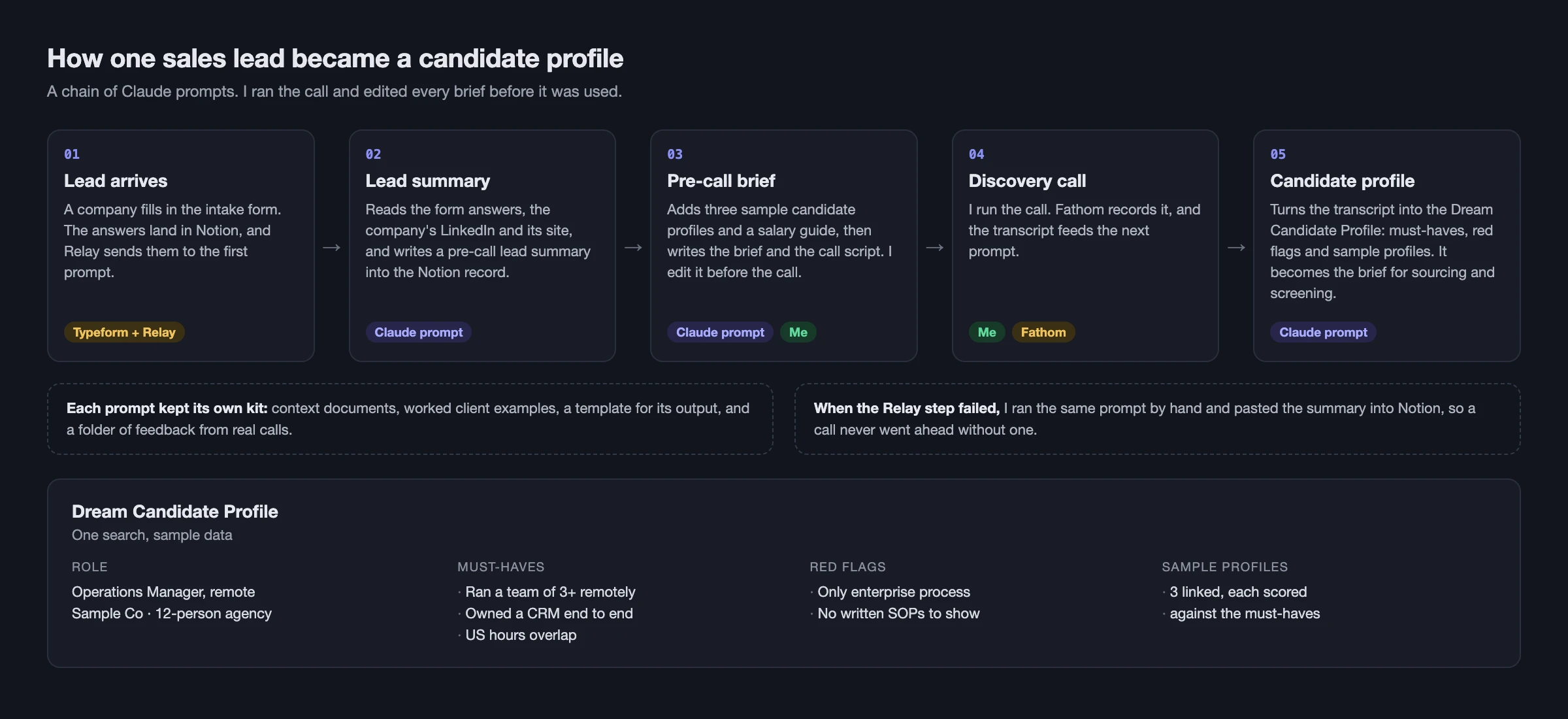
The slow step was screening, so Airtable, Relay and Claude prompts scored applicants against each role’s profile.
5–6 searches
- Relay created the client and project in Airtable the moment a Notion status moved, so nobody copied records by hand
- Claude drafted my screening notes after my first screen by hand
- Zapier first, then Relay
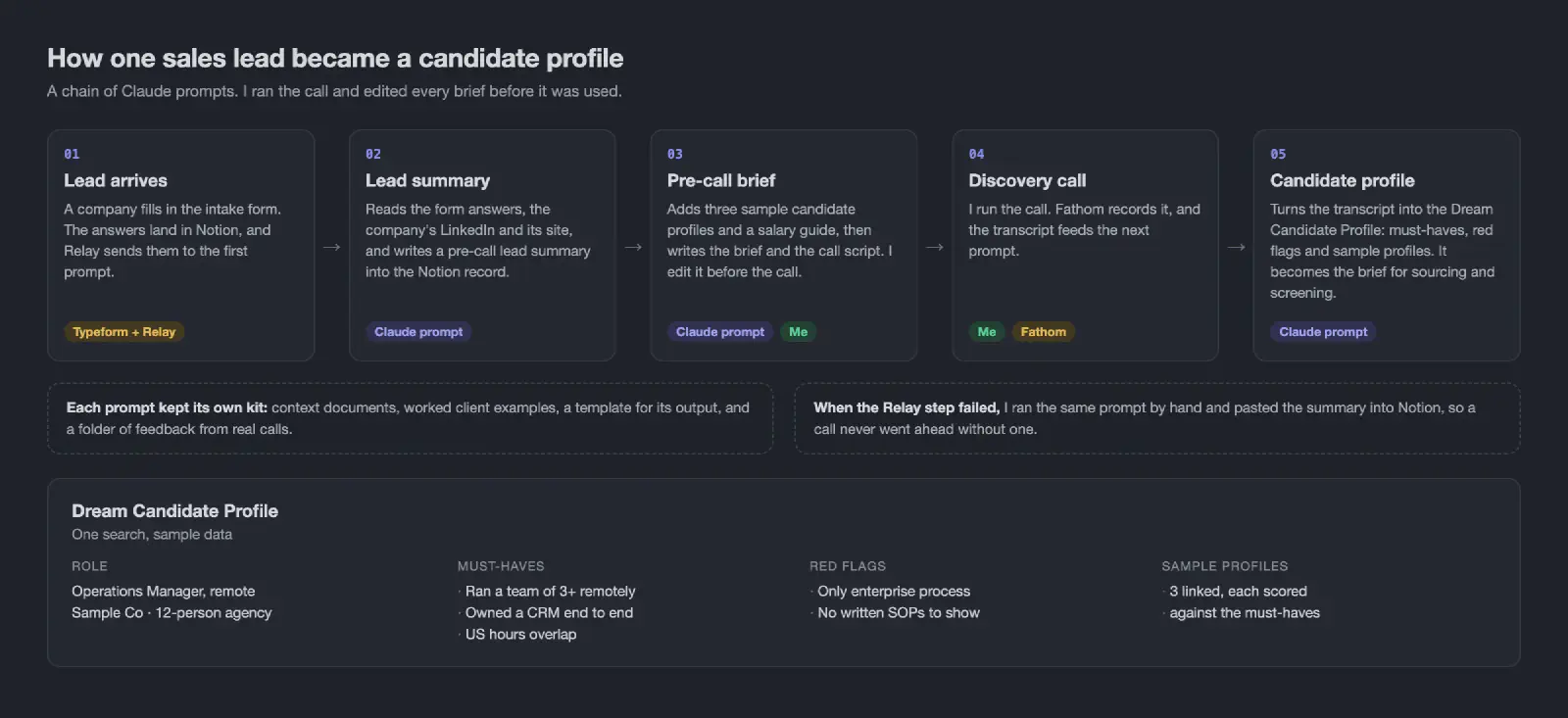
How one sales lead at Genius became a candidate profile. The profile shown is sample data. Open at a time, run by one person from June 2025.
Since February 2026
Matchworks · Go-to-Market & Revenue Operations
I was the lead engineer on an AI system that answered prospects’ replies on its own when its checks passed. Any reply the checks held waited for a person, and each rebuild was measured against the version before it.
27.1 → 5.6 min
- 6,968 of 8,820 replies went out with no person first, 22 July to 2 November 2026
- AI cost fell from $1.72 to $0.92 a lead in August 2026, after the shared rules moved into one cached prompt
- Lead list for April 2026: 10,000+ companies searched on LinkedIn, 3,131 qualified
- 46 Microsoft 365 sending tenants on my tenant report by 18 August 2026
- I wrote the pipeline and its operator console; Mike and Liam built the Langfuse review step with me
Median minutes to answer a reply
From the send log for every sender.



More case studies for this role
How I learn a new field
Mike asked for a video sales letter, a format I’d never written. I built a research library on how the best writers in that format work, and he had a first cut the next morning. His notes on it turned it into the 90-second platform video he wanted.
Your first month with me
One number, picked in week 1, shown next to day 30.
1Week 1
I do the work by hand, in the tools you already use, and write down each step. We pick the one number this month should move, and I record where it stands.
For this roleI do the process by hand and time it, so the automation has a number to beat.
You getEvery step written down, and the one number with where it stands
2Week 2
Each process I take over gets an SOP (standard operating procedure), written steps your team can follow without me.
For this roleThe SOP becomes the spec for the automation, and its tests run on a copy, never on live data.
You getAn SOP per process
3Weeks 3–4
I automate the slowest step first. You decide which calls stay with a person.
For this roleEvery automated step records what it checked, a person reviews what it holds, and I report the cost per run.
You getThe slowest step running on its own
30Day 30
We look at the number together.
You getThat number next to where it stood in week 1
Working with me
$1,500 a month and up
- What I’m open to: a full-time remote role or a monthly retainer, from $1,500 a month, starting with the first month above.
- Hours: I’m in the Philippines (UTC+8). I work 9:00 am to 1:00 pm Eastern or a full Sydney business day, and in those hours I reply within 30 minutes.
- Updates: every shift ends with a written report to you.
- How I work: how I take over a process and how I check my own work.