Genius Oct 2024 – Oct 2025 Head of Recruitment, running its operations
Running a recruiting startup on systems I built
The CEO handed me the operations of his new recruiting startup. I built the systems, trained a small team on them, then ran the business alone from June 2025.
This case is on the role pages for Executive Assistant, Go-to-market and outbound ops, Operations lead, Automation and AI, Support, Recruitment.
“This is extremely promising! Having reviewed the background and videos, we are interested in conversations with all of the candidates.”
“I want to say how much I’ve appreciated working with Genius — the process has been seamless, and the caliber of talent is really strong.”
“Hey Christian, thank you for the thoroughness here.”
“My first two interviews were fantastic.”
From first call to result
- 01 · Me Sales call Qualify the company and the role
- 02 · Me + Fathom Discovery call The call transcript becomes the candidate profile
- 03 · Typeform + Relay Intake A new lead is created in Notion
- 04 · Relay + Airtable Campaign start Client and project records created in Airtable
- 05 · Workable + Smartlead Sourcing Job ads, LinkedIn Recruiter and candidate email campaigns
- 06 · Claude + Airtable Vetting After a first screen by hand, applicants scored against the profile
- 07 · Team, then me Interviews Across 5–6 open searches
- 08 · Me Endorsement Only the candidates I would put my name on
- 09 · Me + Notion Client view Each shortlist sent as Notion candidate profiles
- 10 · Me + CEO Invoice and strategy Billing, planning, and a weekly report on the key numbers from August 2025
Automation or AI Done by a person
The problem
In October 2024 the CEO I had worked for since 2021 started Genius, a recruiting startup that placed offshore talent with growing companies, and handed me its operations. A search runs on many small steps: intake, sourcing, screening, interviews, the shortlist, client updates and the invoice. With 5–6 open searches at a time, every step that waited on a person slowed a search down.
From January to May 2025 I trained and led a small recruiting team on the systems I built, with a senior recruiter and a second recruiter running calls. From June 2025 I ran it alone. In October 2025 the CEO moved me onto his AI content work, and my Genius work ended that month.
What I built
The map above is the whole business. I kept the calls, the interviews and the endorsements, because those were what a client paid my judgment for, and I moved the other steps to tools.
- An Airtable ATS (applicant tracking system) as the back end: 4 core tables (clients, projects, candidates and interviews) with about 100 fields between them.
- Notion as the client side: a Typeform intake created each lead in Notion, and each shortlist went to the client as Notion candidate profiles.
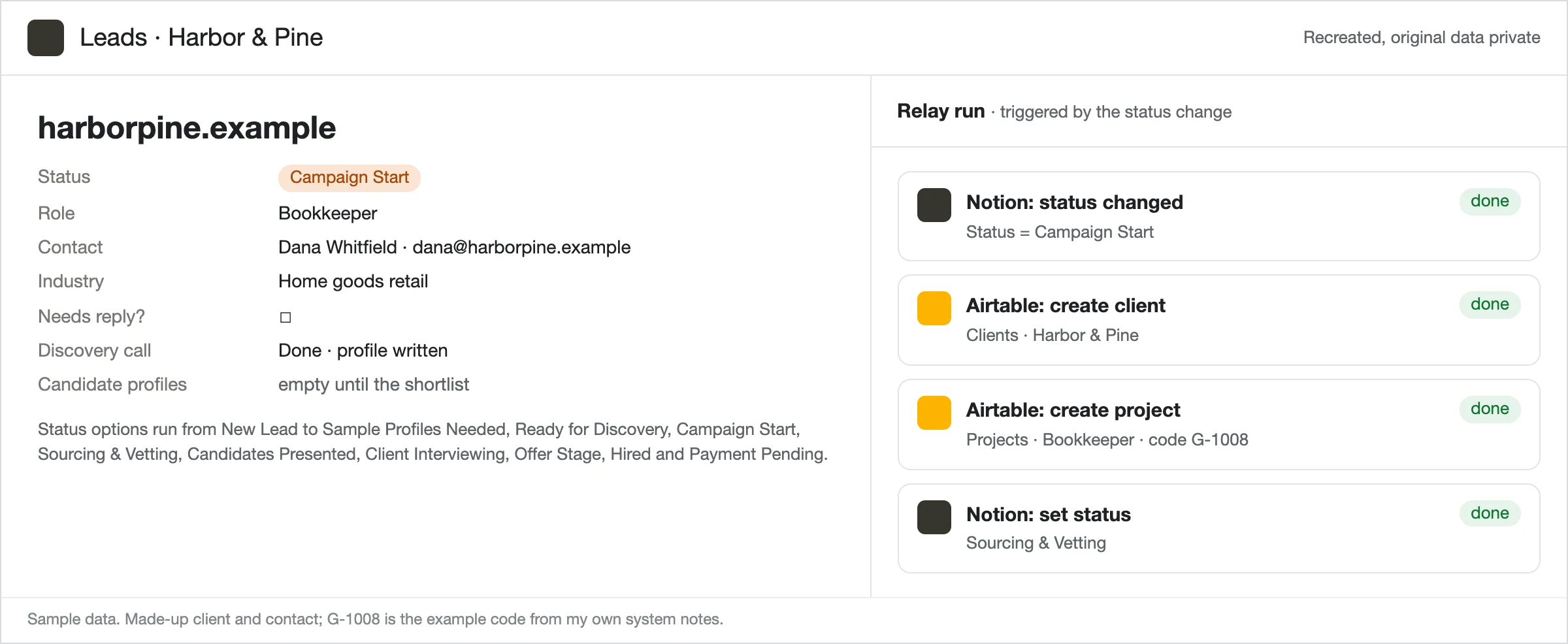
- Relay between them: when the Notion status moved to campaign start, Relay created the client and project in Airtable, with a project code like G-1008, so I stopped copying records by hand.
- Discovery to profile: Fathom recorded each discovery call, and the transcript became a Dream Candidate Profile, the document that described the hire to candidates.
- Sourcing: Workable job ads, LinkedIn Recruiter, Juicebox exports and candidate email campaigns in Smartlead.
- Screening: Claude prompts in Claude Projects scored each applicant against the profile and drafted my screening notes and replies, next to an AI Screen field in Airtable.
- Training and reporting: I onboarded each recruiter on the CRM I had built in Notion. From 1 August 2025 I sent the CEO a weekly report on the key numbers: leads, calls booked and held, and active searches.
Decisions
Airtable for the back end, Notion for clients
I moved the ATS from Workable to Airtable, because Airtable was cheaper and easier to customize for our needs. Clients kept seeing Notion pages, because a Notion profile reads like a finished document and an Airtable record reads like a database row.
Relay over Zapier, Make and n8n
I picked Relay over Zapier, Make and n8n because its plan included AI credits with several models at a fair price, and its integrations were solid. Running n8n with OpenRouter would have meant more parts to maintain, and Relay cost the same as Zapier. The trade-off was Relay’s cap of 750 actions a month, which ruled it out for bulk candidate emails, so in August 2025 I moved those to Smartlead campaigns.
A first screen by hand before the AI
AI screening ran after a quick manual screen, so the AI didn’t spend effort scoring every applicant. The AI drafted notes; the interview and the endorsement stayed with a person.
Asking more on the discovery call
In July 2025 I chose to ask clients more up front on the discovery call and accept the extra friction, because earlier searches had ended in replacements and misaligned hires.
One search, start to finish
I follow one Financial Analyst search, from how a client came in to the 2 hires on 12 September 2025, then one ordinary day from my log, on screens recreated with made-up names.
1. A new client fills in the intake form
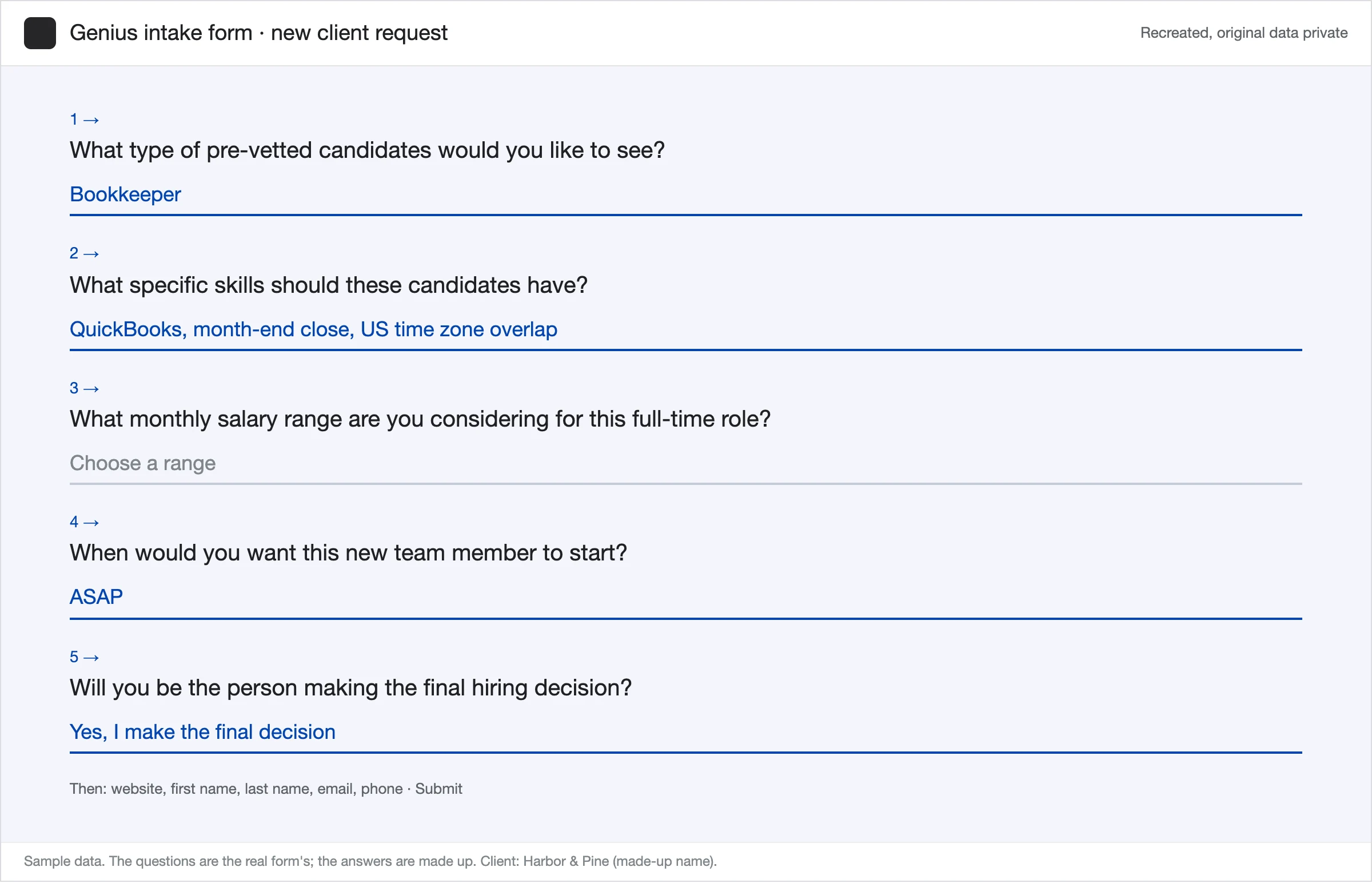
From April 2025 every new client came in through a Typeform form: the role, the skills, the pay range, the start date and who decides. Each answer became a new lead in Notion.
2. Campaign start creates the Airtable records
When I moved a lead to Campaign Start in Notion, Relay created the client and the project in Airtable, with a project code, and set the lead to Sourcing & Vetting.
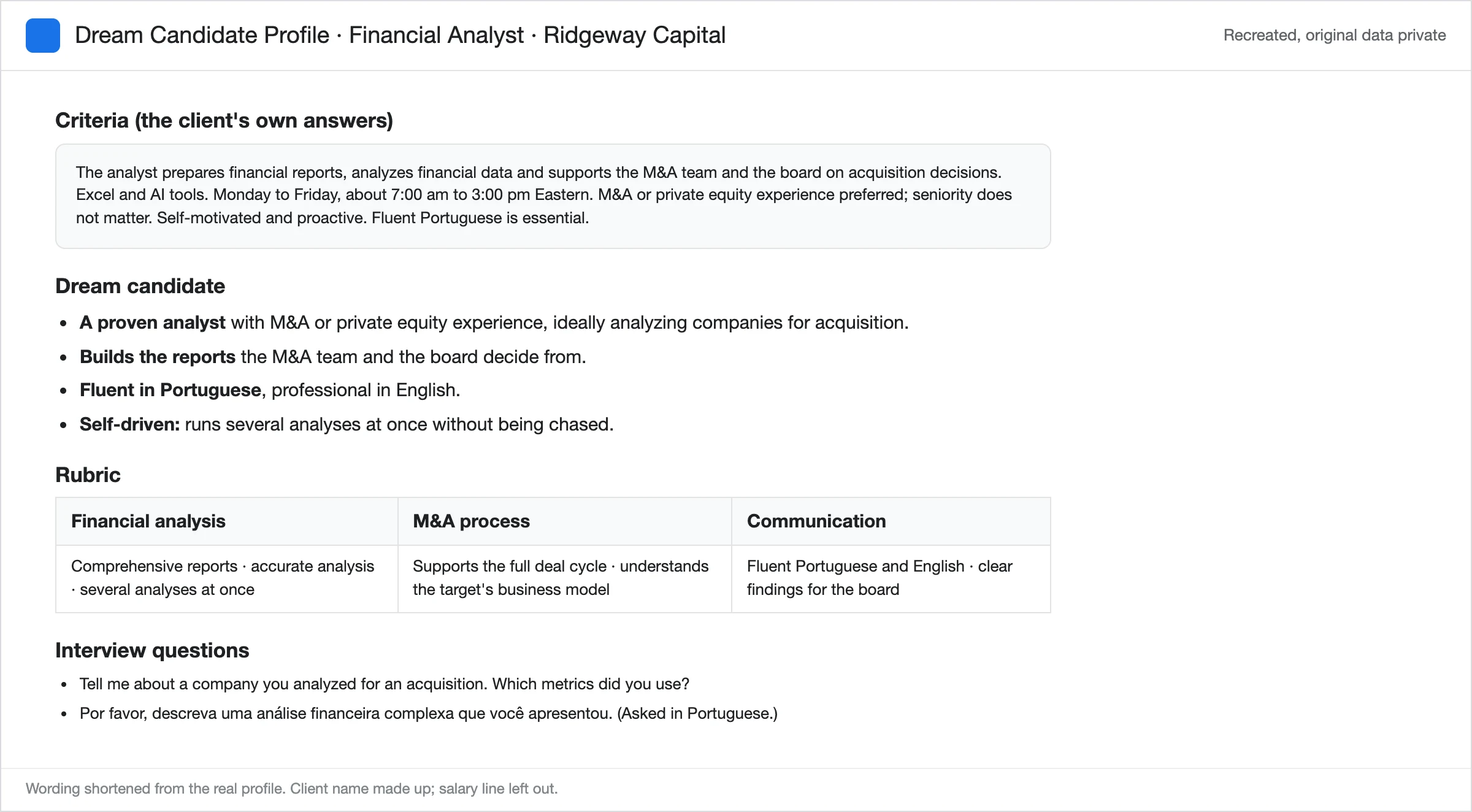
3. The Dream Candidate Profile
This client, an investment firm, first hired a Financial Analyst through us in January 2025. I had written the profile on 30 December 2024 from the client’s own answers: board-level reports, M&A experience, fluent Portuguese. When the client came back in late August 2025, I reused it.
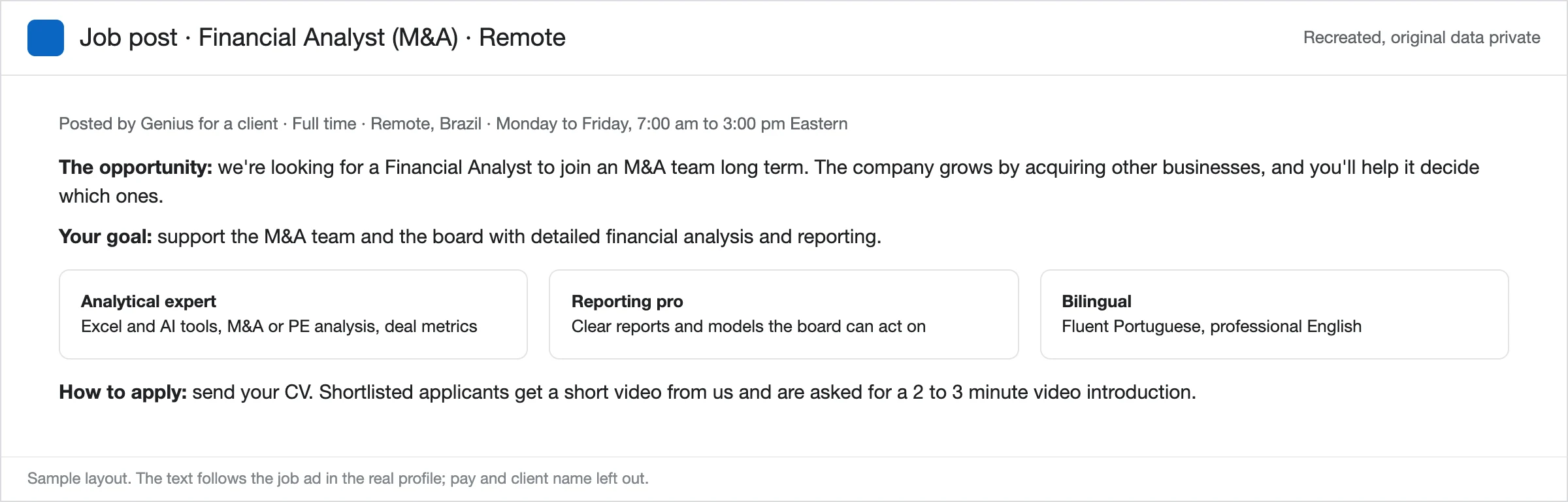
4. The job ad goes up
On 27 August 2025 my note for the next day said to post the listing for this client quickly, because they move fast and pay fast. The ad came straight out of the profile.
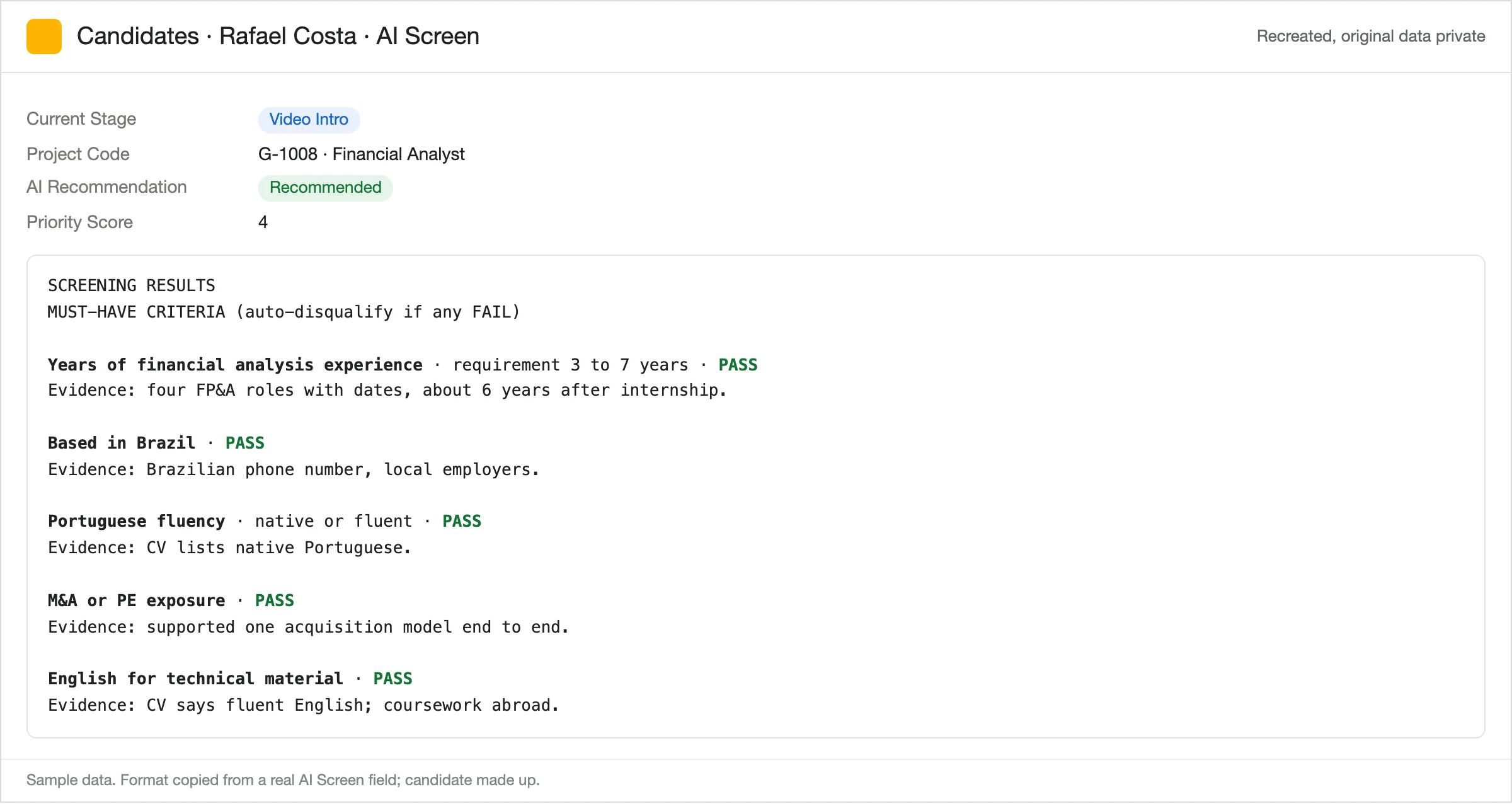
5. Screening
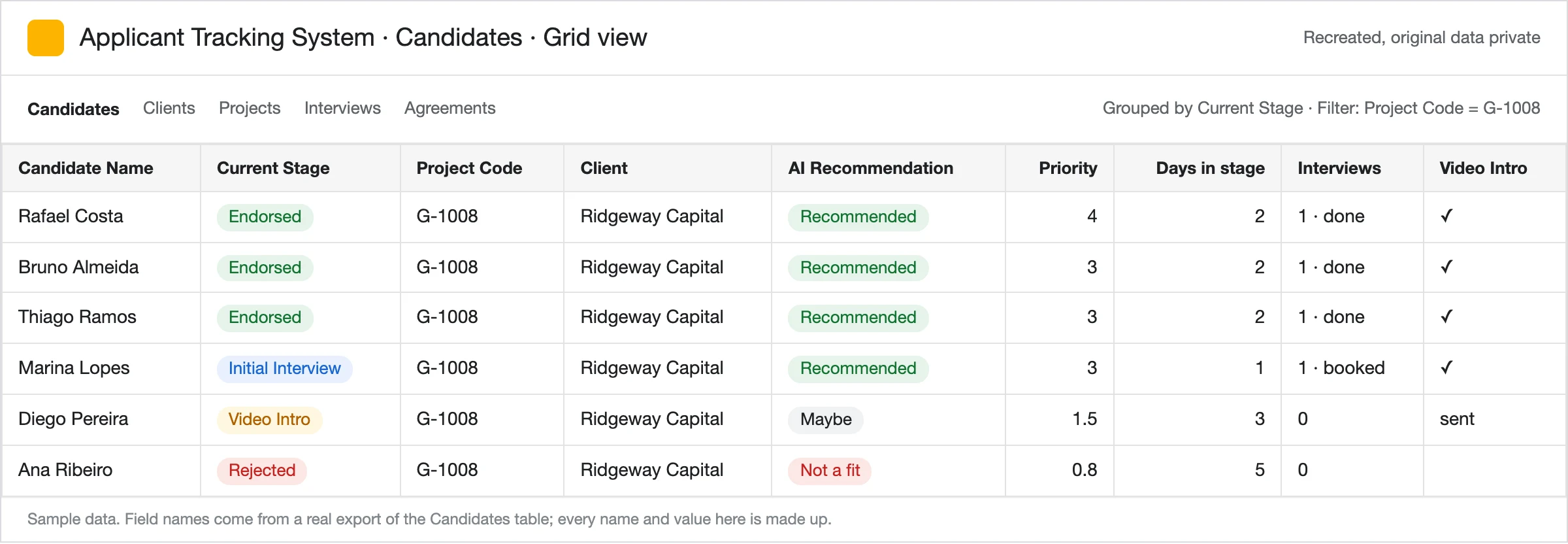
I screened the applications by hand first. Then a Claude prompt scored each one against the profile’s must-haves and wrote the result into the AI Screen field in Airtable. 44 applicants were invited to record a video and 37 did.
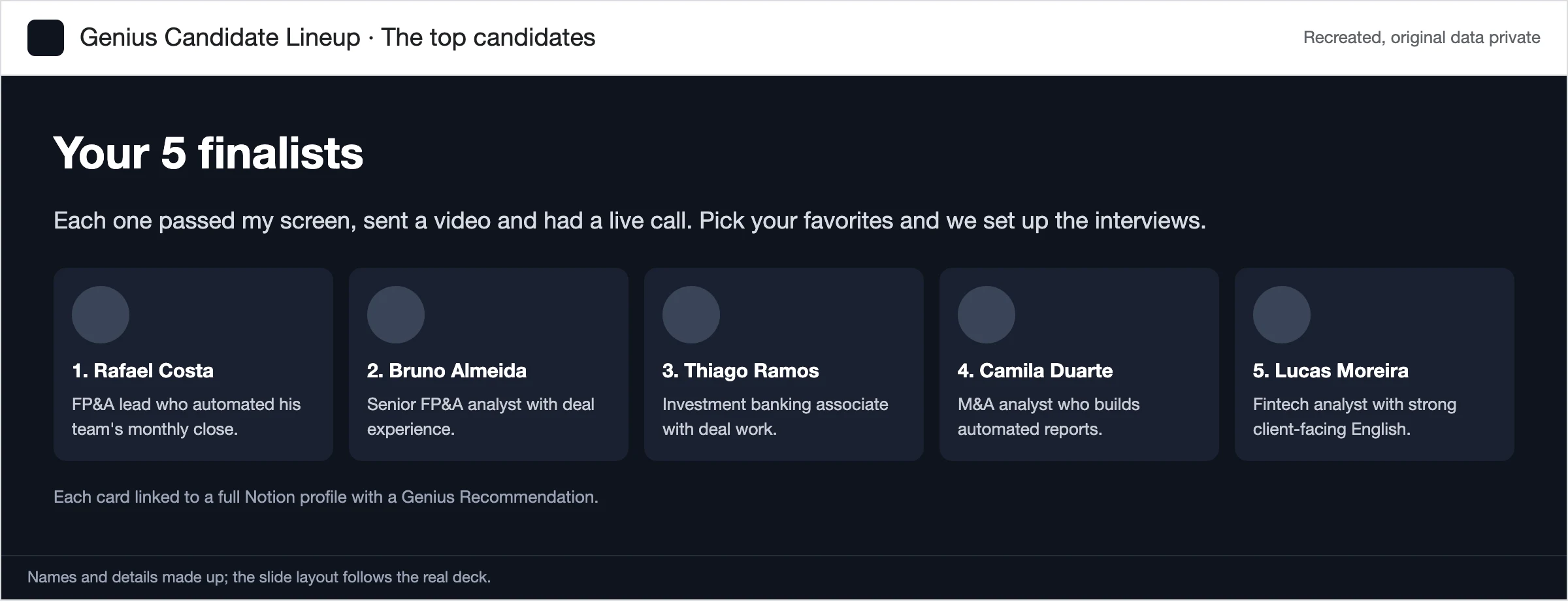
6. The lineup goes to the client
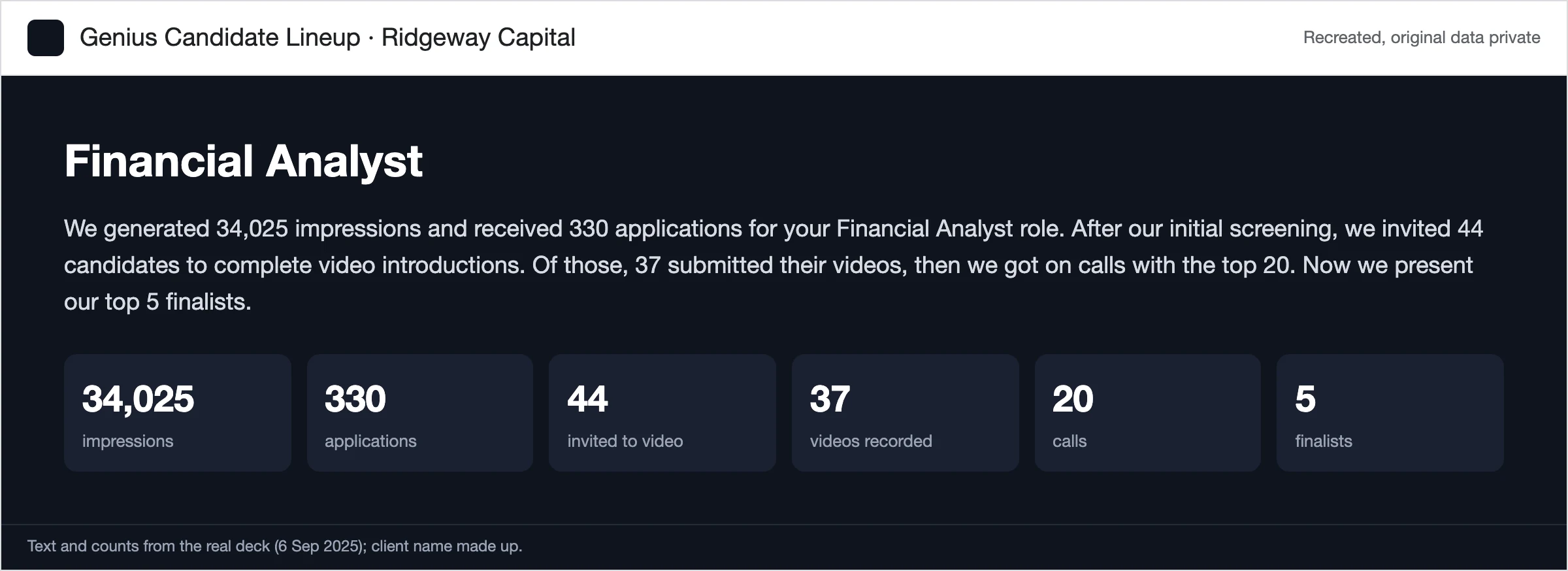
I held calls with the top 20 and picked 5 finalists. On 6 September 2025 I built the Candidate Lineup deck: 34,025 impressions, 330 applications, 44 invited to video, 37 videos, 20 calls, 5 finalists. The client interviewed them the week of 8 September.
7. Two hires, and the weekly report
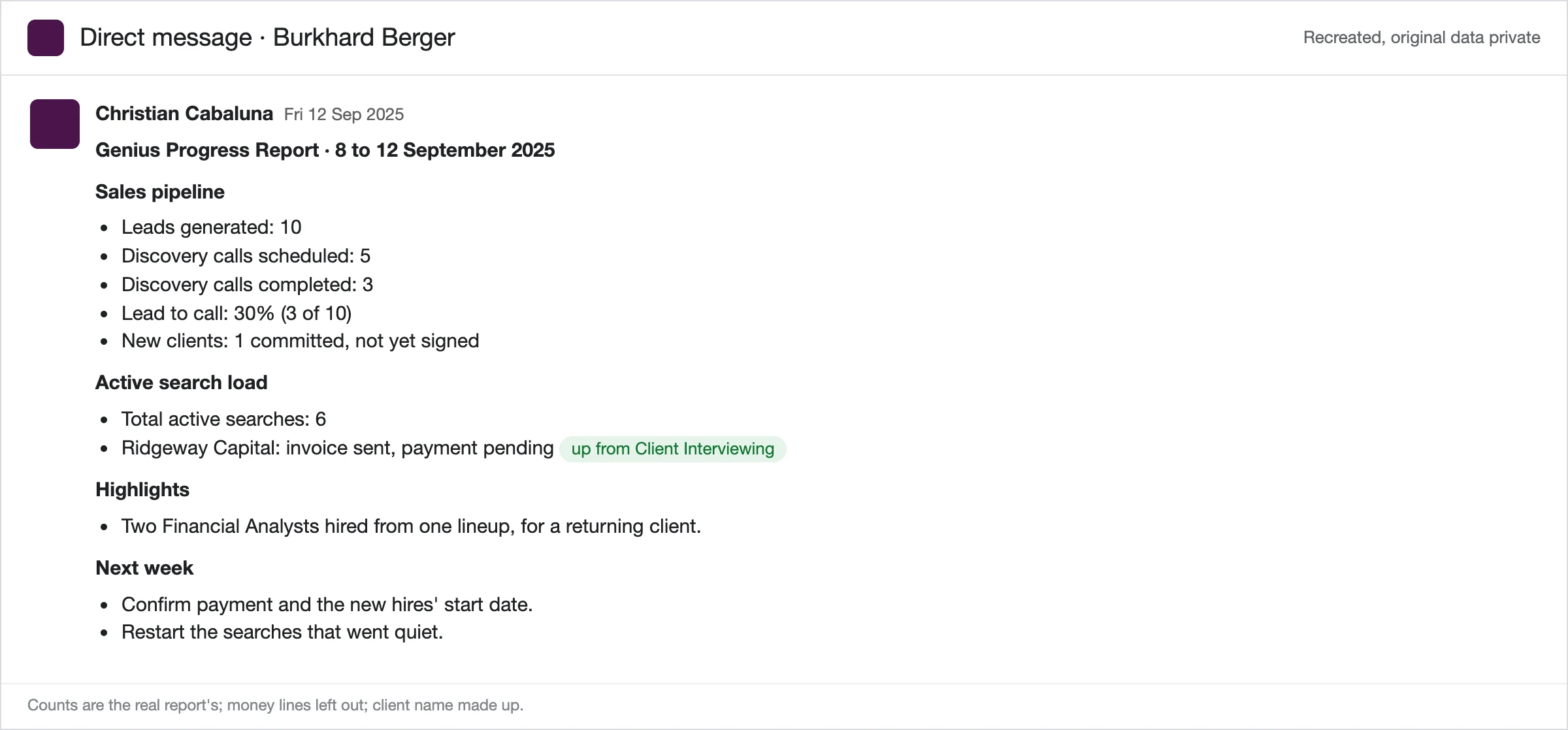
On Friday 12 September 2025 the client hired 2 of the 5. I wrote both onboarding checklists and sent the invoice for 2 placements that day. My weekly report to the CEO counted 10 leads, 5 calls booked, 3 held and 6 open searches.
8. One ordinary day
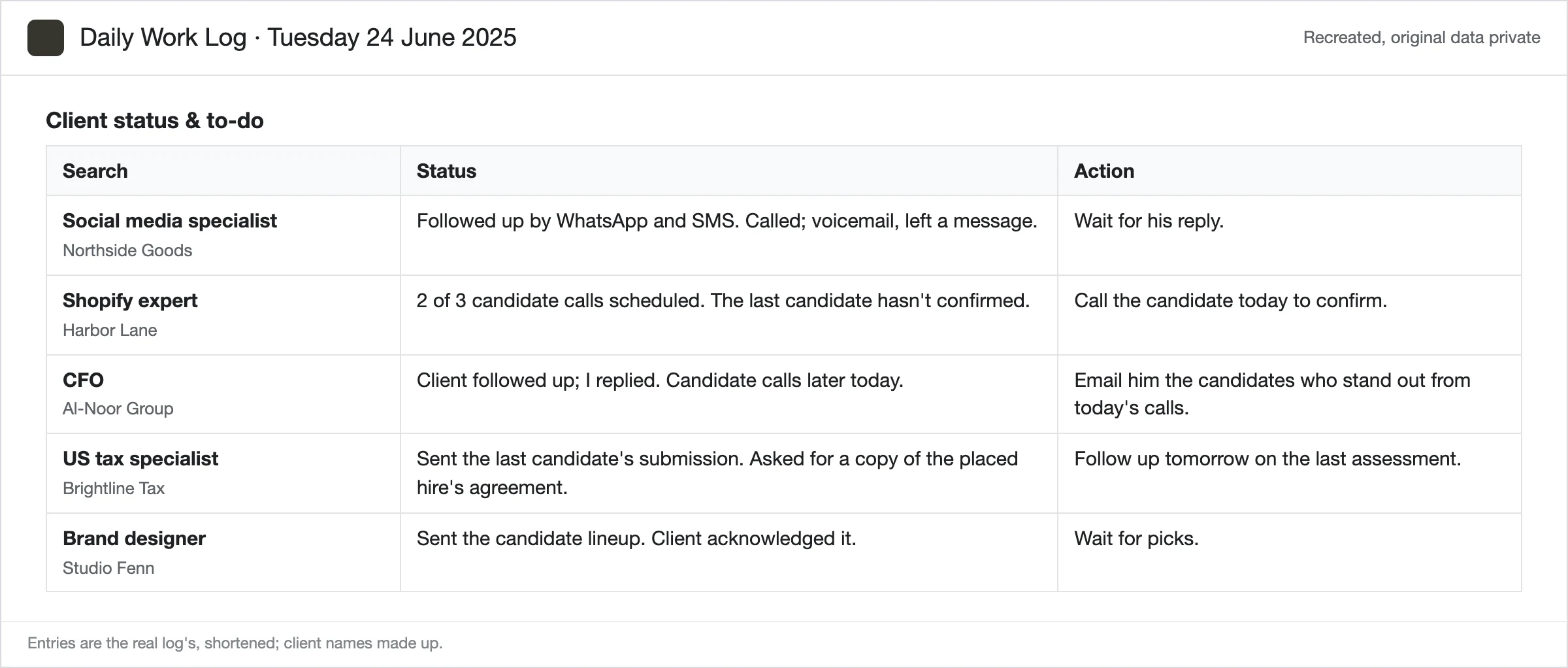
Most days were five searches at once. On Tuesday 24 June 2025 I chased one client by WhatsApp, SMS and a call, booked candidate calls for another, held CFO candidate calls, sent a tax client the last candidate, and waited on picks from a lineup.
The result
- One Brand Designer search, 3 June to 31 July 2025: 912 applied, 179 assessed, 9 interviewed, 3 endorsed and 2 client interviews.
- One Financial Analyst campaign reached 34,025 impressions and brought in 330 applications. 44 candidates were invited to record a video, 37 did, 20 got a call and 5 went to the client as finalists. It was a repeat client: it first hired a Financial Analyst through Genius in January 2025, hired 2 of these 5 on 12 September 2025 and an M&A Analyst in October 2025, then opened two more searches, in November 2025 and January–February 2026.
- On one CFO search, by my journal on 21 July 2025, 238 candidates emailed gave 16 replies and 4 qualified candidates.
- 71 inbound client requests came through the intake form from 10 April to 9 July 2025 (intake form export).
The pipeline I reported weekly. Every weekly report to the CEO in the records, all from 2025, with its own counts. Booked and held are sales calls, clients are new clients; searches are the searches open that week. No report survives for 11–15 August, 25 August to 5 September or 15–19 September.
| Week | Leads | Booked | Held | Clients | Searches |
|---|---|---|---|---|---|
| 28 Jul–1 Aug | 8 | 6 | 4 | 0 | 1 |
| 4–8 Aug | 12 | 8 | 4 | 1 | 6 |
| 18–22 Aug | 6 | 5 | 3 | 1 | 5 |
| 8–12 Sep | 10 | 5 | 3 | 1 | 6 |
| 22–26 Sep | 4 | 4 | 1 | 0 | – |
The 4–8 August client signed after a call from an earlier week, and the 8–12 September client committed but had not yet signed. The 22–26 September report gives no search count.
What I’d change
I’d start on Airtable from the first search and never pay for Workable.