Personal 2024 – present Builder
The AI setup I work from
How I get work out of AI that I can trust without reading every line of it, and where it ran for Matchworks, Genius and my own tools.
This case is on the role pages for Executive Assistant, Automation and AI.
The problem
AI writes fast, and someone still has to check what it wrote. When I read every output myself, my reading speed caps the whole team. At Matchworks on 28 July 2026 I was exactly that: I read every reply draft before it went out, and the median prospect waited 27.1 minutes. That night Mike, who runs Matchworks, wrote “we have analtyics showing < 15m response time conversion goes way up”.
How I solved it
I run my work through Claude Code, an AI assistant that works inside a computer and writes code from plain English. Everything in my setup does one of three jobs.
1. Write the procedure once. A skill is a written procedure the AI follows: when to use it, the steps, its reference notes and scripts. I have 66 of them, and the Matchworks repo holds another 107. When a run works, it becomes a skill: the night described below became the case-study skill at 2:08 am on 10 November 2026. Skills also carry what I learn from a field’s best operators: the cold email libraries I built from them fed the outbound language I wrote at Matchworks.
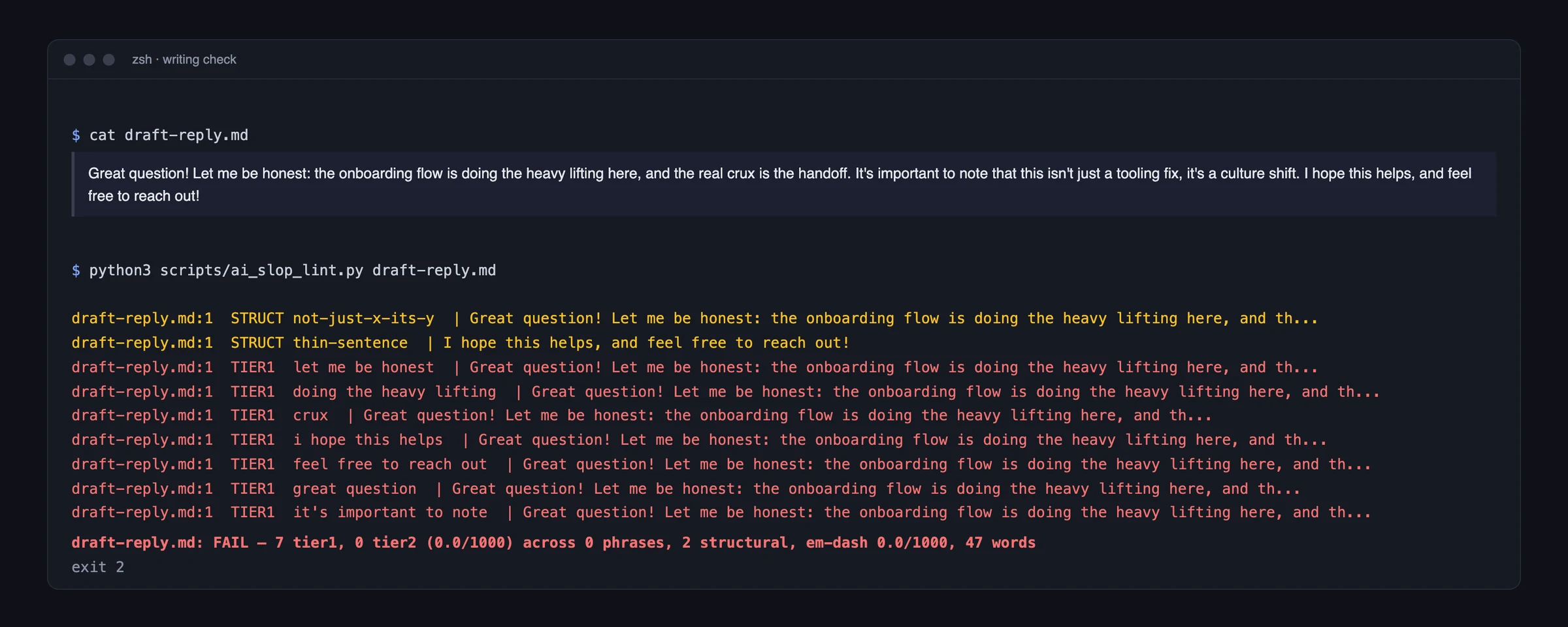
2. Check every output, not some. 15 checks run on their own while I work. The one I lean on most is a writing check I built on 28 July 2026: it sends back any reply or page that still reads as AI-written. It has run 5,517 times since and caught 143 banned phrases. From 1 October 2026 the Matchworks reply system ran the same check on its drafts, next to rules I wrote from my notes on real replies.
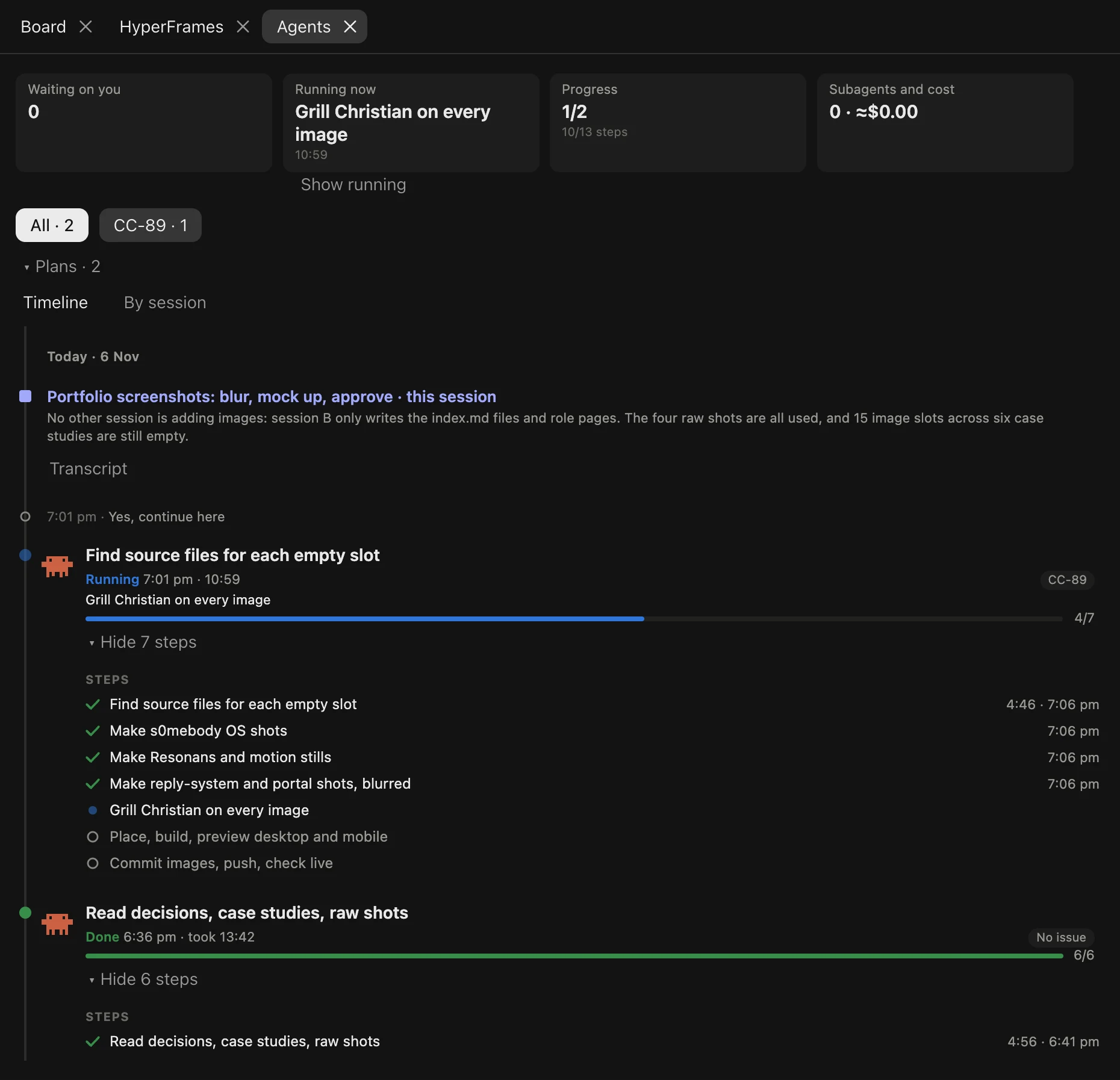
3. Keep the record, and let it win. My context, rules and decisions live in one repository, with notes in Obsidian. Every piece of work is a Linear ticket. When I open a session, a board of my open tickets loads first, and the session’s plan shows as steps in a side panel next to its ticket. When the session ends, it posts what came of the work as a comment on that ticket, and a small AI check stops it from closing if no outcome was recorded. Since 18 August 2026 that board has held 191 tickets and 1,217 comments recording what each session did. 13 scheduled jobs write a news digest, a summary of my day and a self-review into my notes, 772 briefs since 25 July 2026. When the record and my memory disagree, the record wins, including about me: the Novum night below is one example.
Where it ran
- Matchworks reply system, Feb to Nov 2026. I built it in Claude Code on the same three jobs. The AI drafted, a separate program checked every draft as it sat in the inbox, and a draft that failed waited for a person with its reason in writing. It sent 6,968 of 8,820 replies with no person first and cut the median reply time from 27.1 to 5.6 minutes. From 3 to 25 August I graded 324 sent replies one at a time and marked 6 wrong. When 3 replies went to the wrong person on 1 and 2 October, a draft addressed to the wrong person was held from then on. Operators who aren’t engineers worked the held queue from a Raycast console I built. Case page
- Genius, 2024 to 2025. After my first screen by hand, Claude prompts scored each applicant against the role profile and drafted my screening notes, which is how I ran 5–6 searches at a time on my own. Case page
- Rebuilding my 2024 site-scoring tool, Oct to Dec 2025. I wrote the specs and Claude Code wrote most of the code: a batch system with job queues and a live dashboard, 147 commits in 9 weeks. Case page
- Matchworks client portal, Sep to Nov 2026. Claude Code pulled the PostHog numbers and drafted the tickets from my replay notes. 19 were filed by 7 November and 4 shipped. Case page
One run: turning my Novum years into case pages
On 9 and 10 November 2026 this setup turned my Novum work into 8 case pages in about 7 hours, and the records overturned my own memory once along the way.
1. The ask
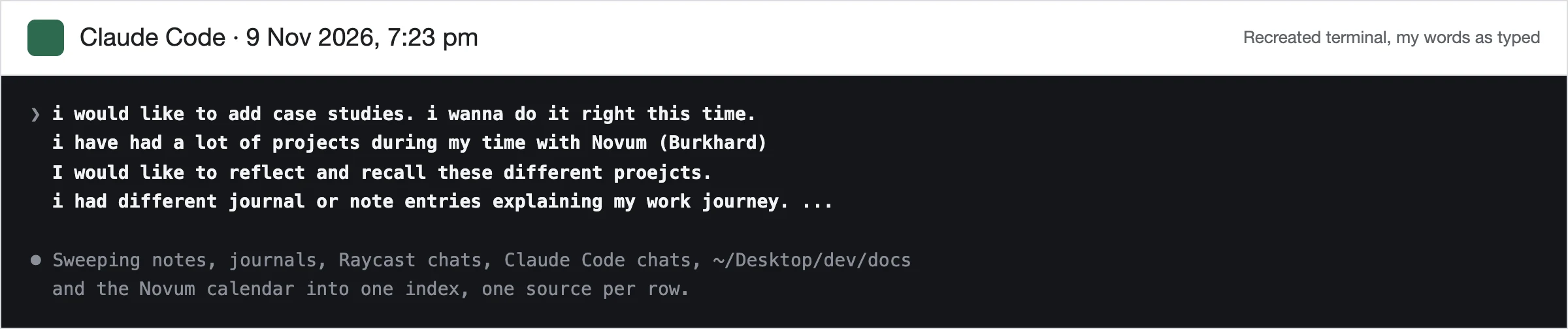
At 7:23 pm on 9 November I asked Claude Code to help me recall my Novum projects and write them up properly this time, from my old journals and notes.
2. The sweep and the index
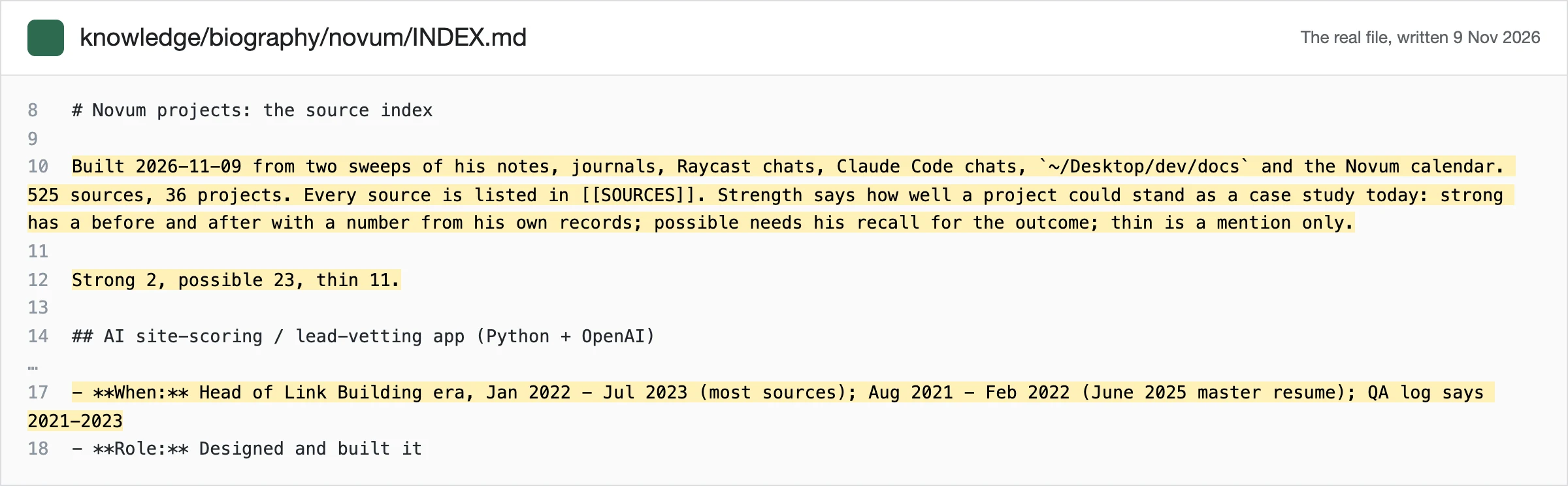
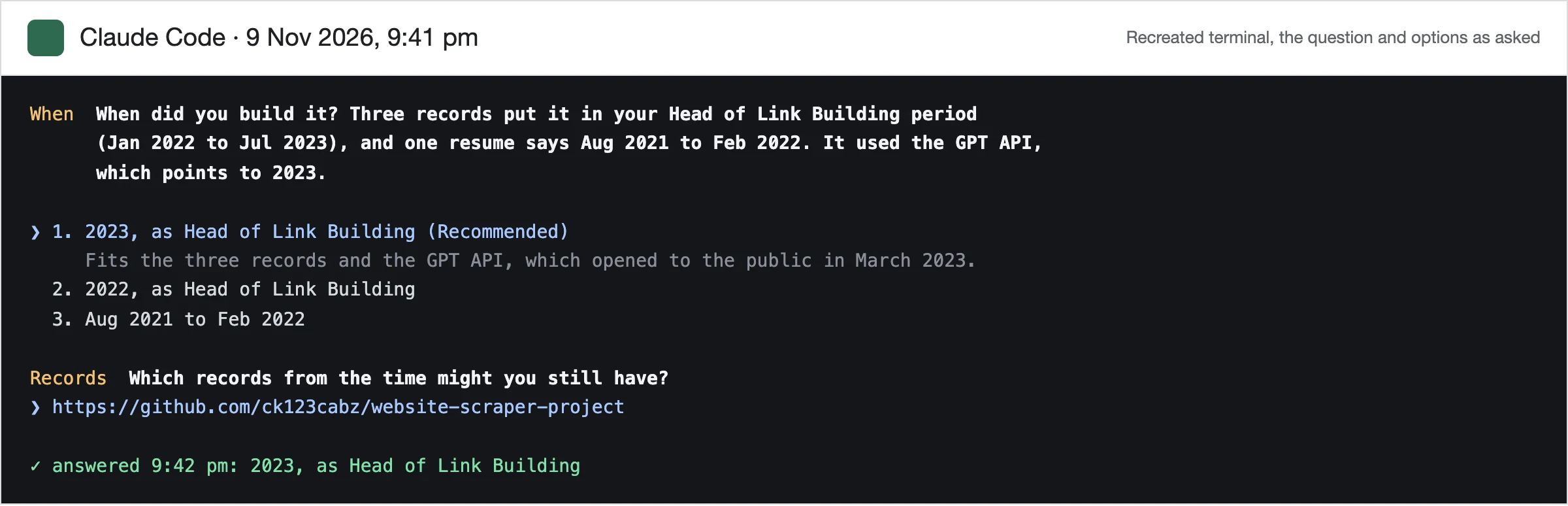
Agents swept my notes, journals, Raycast chats, Claude Code chats and the Novum calendar into one index: 525 sources and 36 projects, each graded strong, possible or thin. The site-scoring tool came out strong, and most sources dated it to my Head of Link Building years, 2022 to 2023.
3. The grilling round
At 9:41 pm Claude asked me when I built the tool, with its own pick first, 2023, and I took it. The same round asked which records from the time I still had, and I gave it the tool’s GitHub repo.
4. The record
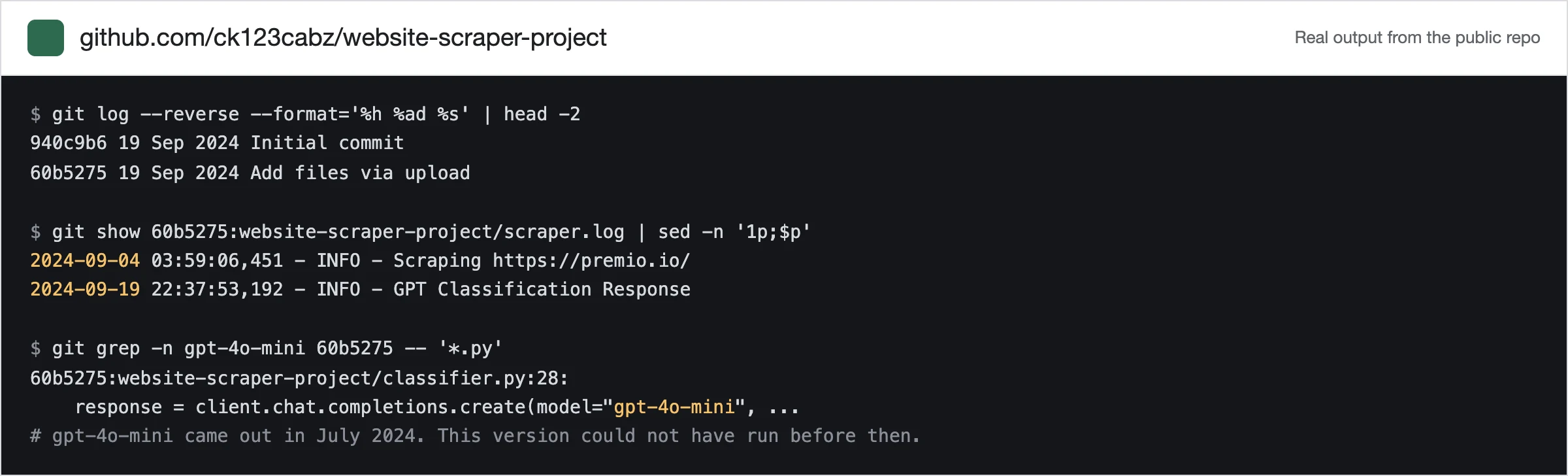
The repo’s first upload is dated 19 September 2024. Its log runs from 4 to 19 September 2024, and the code calls gpt-4o-mini, a model that came out in July 2024. That version of the tool could not have run in 2023.
5. My memory, overturned
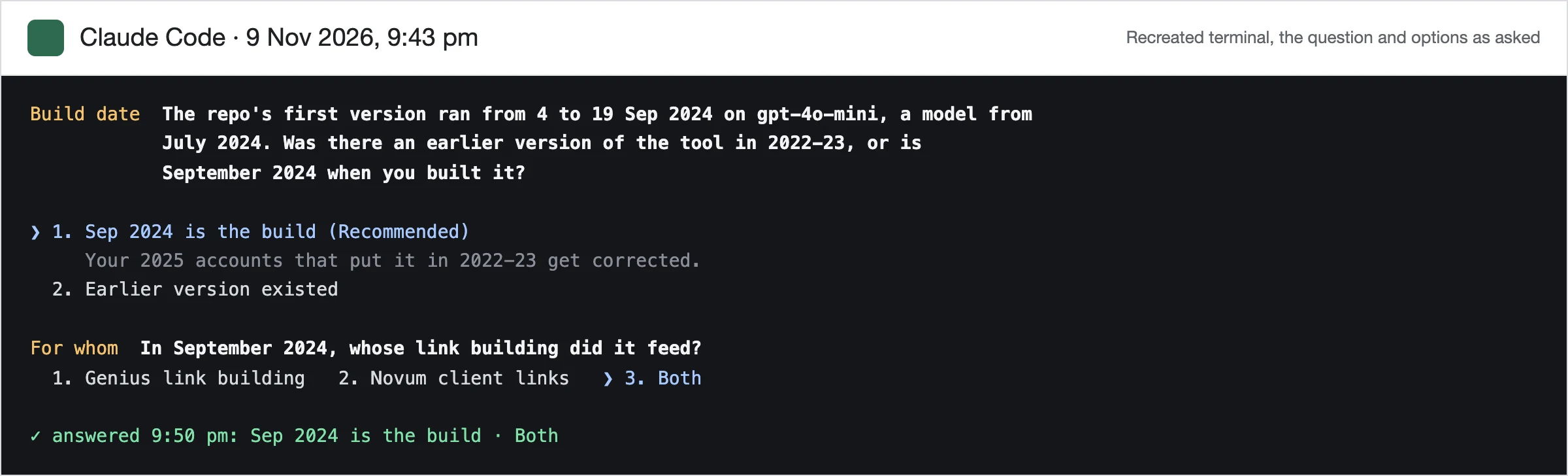
At 9:43 pm the next question put the record to me: was there an earlier version, or was September 2024 the build? I answered at 9:50 pm that September 2024 was the build, and that it fed both Novum’s and Genius’s link building.
6. The answers file
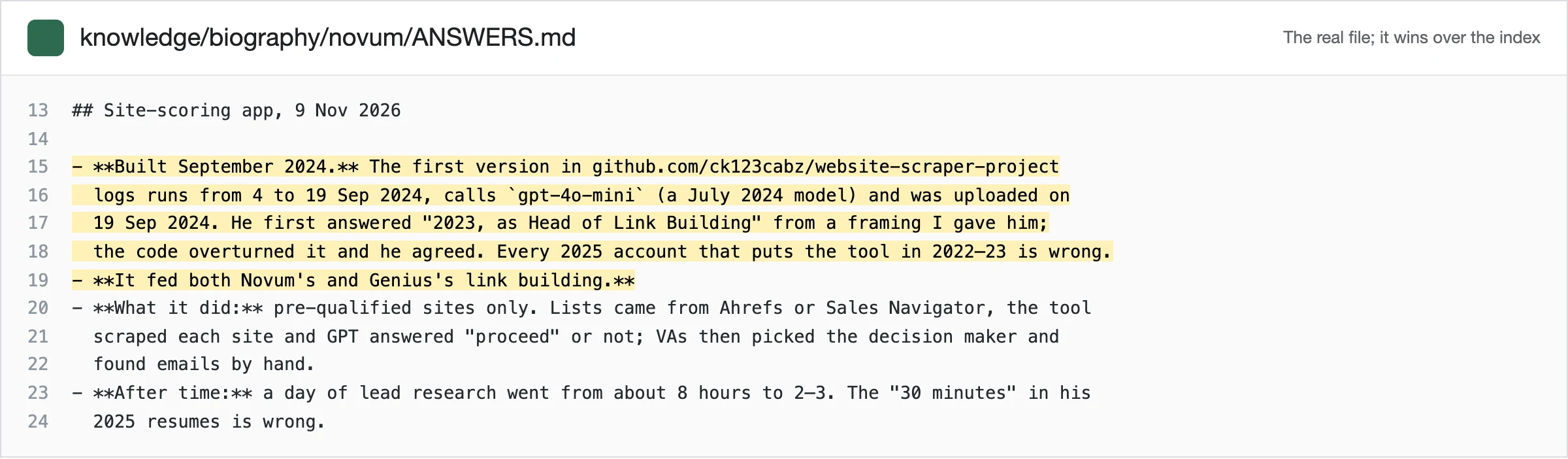
Every settled fact goes into ANSWERS.md with the evidence behind it, and that file wins over the index. It records my first answer, that the code overturned it, and that every 2025 account dating the tool to 2022 or 2023 is wrong.
7. The published page
At 1:12 am on 10 November I had the 8 Novum pages written from ANSWERS.md. They were committed at 1:15 am and on the live site by 2:31 am, with the tool dated September 2024. At 1:25 am I approved turning the run into a skill, case-study, so the next employer’s projects go through the same steps.
Also built on it
- A product reel, animated in code. On 6 and 7 October 2026 I built a 31.9-second Matchworks reel in HyperFrames, a tool that turns an animated web page into video. Every scene is HTML, and the music is generated by code at 128 beats a minute, so every cut falls on a beat. I posted it at 12:37 am on 7 October, and that evening Mike asked for a sales video. Every video project ends with a lessons file, and the next one starts by reading all of them: 9 projects since 1 October. Case page
- Research libraries and public wikis. Agents pull the videos, posts and interviews of a field’s best operators and work through them in three passes: tag each claim with its source, compare sources, then keep what holds as notes an AI can work from. That’s 31 libraries so far, from cold email to Claude Code itself. A library can also review a draft or a decision by that field’s rules alone; 21 are set up that way. Some become public wikis, 471 pages across six of them, and on one, a second agent checked each of 15 worked examples claim by claim and found 23 small errors.
What it would do in your business
The same three jobs on your work: write the procedure once so anyone, person or AI, runs it the same way; put a check on every output so nobody has to read everything; and keep one record your team trusts over anyone’s memory.
What I’d change
I’d start with one repository for my context and rules from day one. Before that, my memories and rules sat in a master projects folder and several repos, and the work kept getting lost between them.