↓Skip to main content

Tigdukiduki, a Facebook page Oct – Nov 2026 Editor and producer

Three episodes of a Filipino explainer, made in Claude Code

A Taglish video series on why the Philippines stayed poor, made with a friend. I ran the scripts, the renders and the viewer tests in Claude Code, and kept the record of every step.

Claude CodeHyperFramesMotion design
5:49 Episode 1 as posted, from a 2:36 script
55 things four lens walks found in the Episode 2 draft
60 simulated viewer runs on Episode 3 openings

The problem

My friend Sai wrote a video series in Taglish, the everyday mix of Tagalog and English, on why the Philippines stayed poor while its neighbours grew. It follows the book Why Nations Fail. On 11 October 2026 he gave me his project files and I forked them, to see whether my Claude Code setup could make the episodes better.

Neither of us had made an explainer before. So every call had to be checked against something: a reader who had never seen the script, a source text, or the numbers from the last episode.

What I built

  • Episode 1, “Bakit Hindi Umaasenso?”: 5 minutes 49 seconds, animated in code with HyperFrames, voiced by Sai, posted on 15 October.
  • Episode 2, “Mula pa nung Kastila”: the script, rewritten nine times in Claude Code. Sai recorded it, built the cut and posted it on 2 November.
  • Episode 3, “Ang lupa”: a new script, four rendered test openings and a panel of six simulated viewers, still in test on 12 November.
  • A recording page: Sai reads one line at a time on his phone and the takes come back as files.

Every step below comes from the Claude Code session logs, the project files and our Linear board. Times are Philippine time.

Episode 1, from Sai’s script to the post

Episode 1 took 5 days, from my fork on 11 October to the post on 15 October.
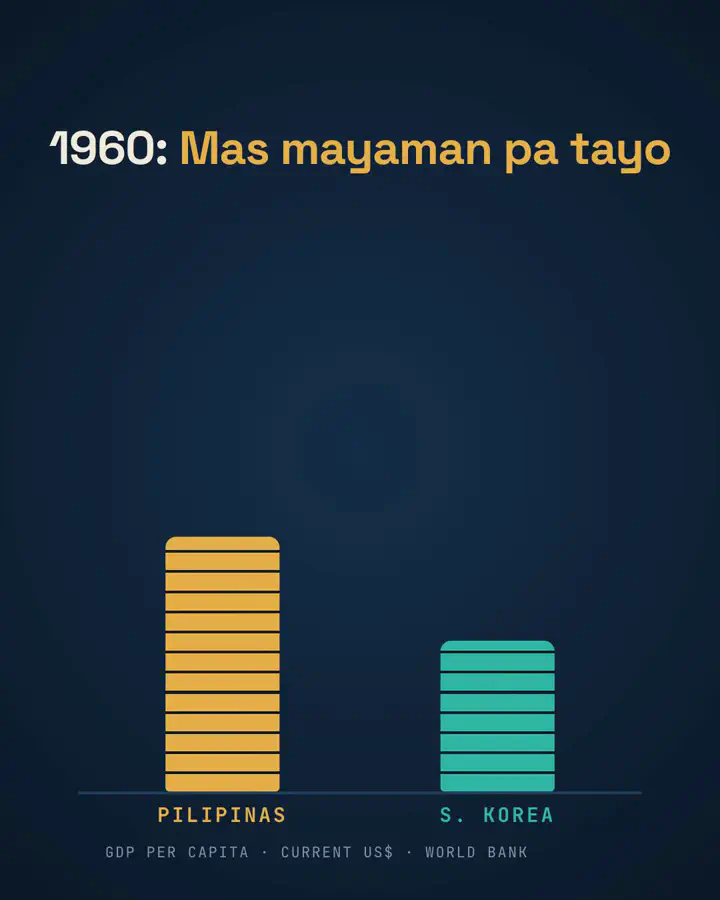
One opening frame, five renders
13 Oct, 2:06 am
Melets do an a/b test. create the full reel through the content creation workflow we have.
Claude CodeVoiced the script with ElevenLabs, built every scene as HTML in HyperFrames and rendered a first draft by 3:11 am.
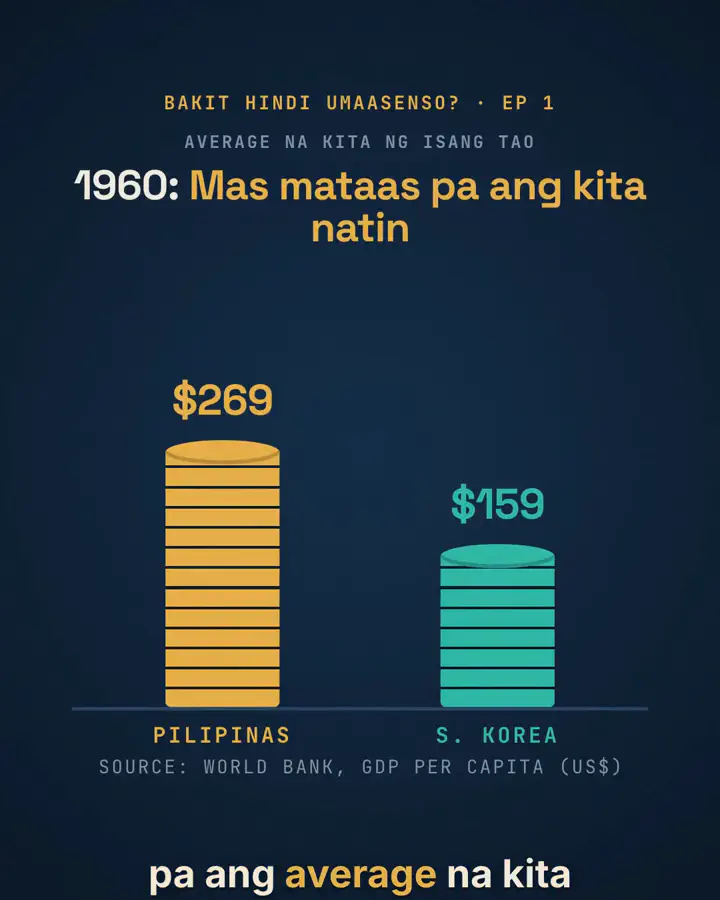
v1 · 3:52
Render v1: two coin stacks, Pilipinas taller than South Korea, under a small 1960 headline.
13 Oct, 3:16 am
Mei watched it and i would like to see this fully ready for production. do you very best!
Claude CodeRan three rounds of fresh readers on the frames, fixed what they misread, and added the dollar figures and the source line.
v4 · 3:55
Render v4: the same coin stacks, now labelled $269 and $159 with a World Bank source line.
13 Oct, 1:33 pm
Mecan we time the script properly. we're not taking into account the proper pauses (to guide the viewers attention properly). overall, the voice feels rushed.
Claude CodeMeasured the voice at 168 words a minute with 0.3 seconds between lines, slowed it, wrote the pauses into the script and rebuilt the animation on one chart.
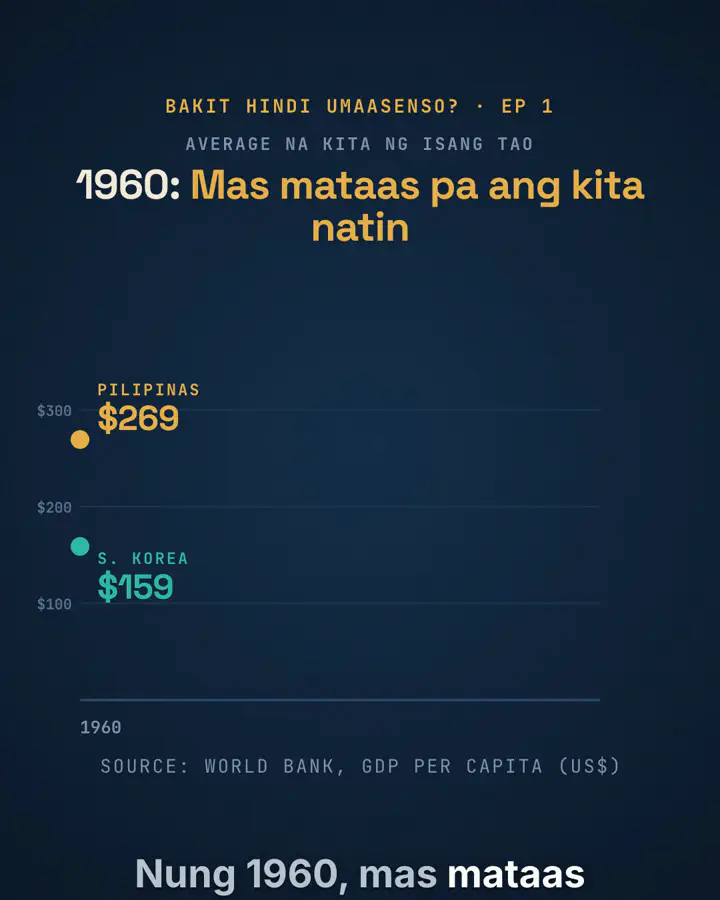
v6 · 4:43
Render v6: the coin stacks are gone; two dots on a chart at $269 and $159 in 1960.
13 Oct, 5:19 pm
Methis is our hook, right? So it must be optimized visually to be a hook. So maybe like the headline should be hooky.
Claude CodeMade the headline the line a thumbnail would carry, added the +69% bracket and a chapter bar, and switched to a new narrator voice.
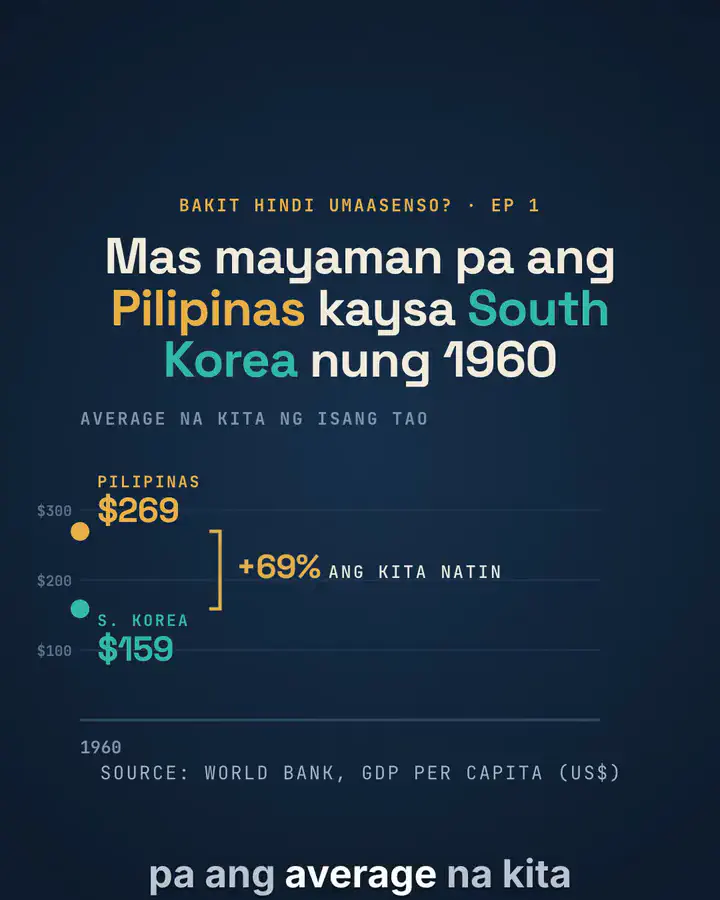
v7g · 5:47
Render v7g: a large headline, Mas mayaman pa ang Pilipinas kaysa South Korea nung 1960, over the chart with a +69% bracket.
14 Oct, 8:42 pm
Mesome parts sound like it's glitching. not sure if its because we sped up some parts of sai's takes but i fthat's the trade off then we pick quality.
Claude CodeFound 73 clicks on the joins between the audio blocks the recording page saved, redrew them, and re-timed every picture to Sai's voice. The frame stayed; the sound under it changed.
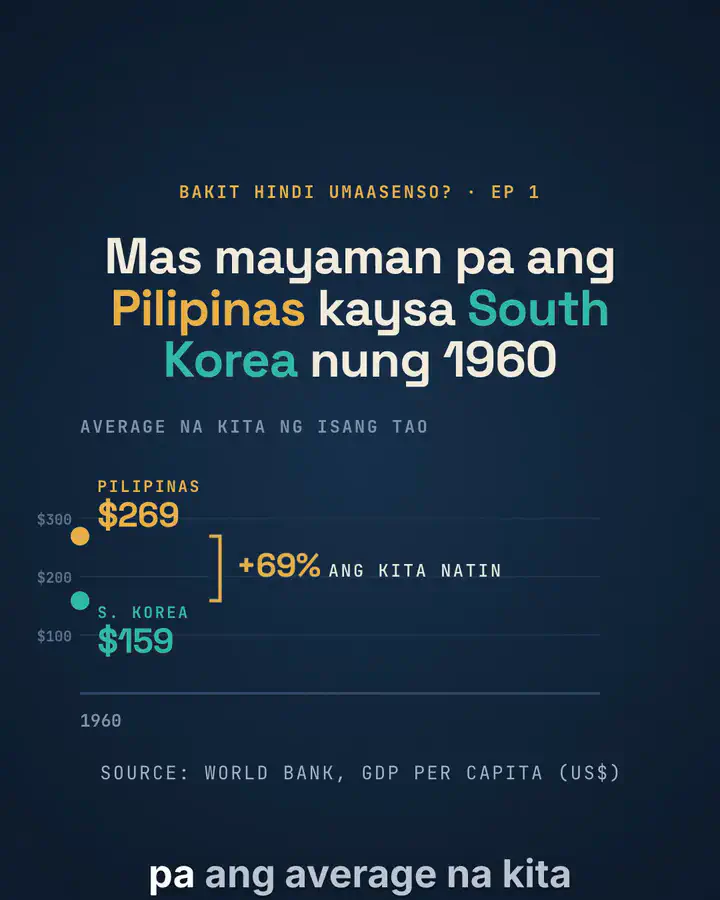
v8e · 5:49 · posted
Render v8e: the same headline and chart as v7g, now under Sai's recorded voice.
My messages are quoted from the Claude Code session logs of 13 to 15 October 2026. Each frame is 3 seconds into that render.

1. The fork

At 4:29 am on 11 October I asked Claude Code to stress test Sai’s script. It ran 9 agents: 4 gathered facts and lessons, 2 rewrote, and 3 read both versions blind as a 24-year-old viewer in Dumaguete. The rewrite won all 3 reads. For Episode 1 the readers put the chance of finishing at 38% and 44%, against 29% and 33% for Sai’s.

2. A fix that made it worse

At 5:05 am I said we were skipping too many links between ideas. The next pass added them, so the script grew from 475 words to 710 and the readers’ chance of finishing fell from 55% to 40%. That showed the question was too wide, so I narrowed it to who had the power to block land reform.

3. Taglish, then four lenses

On 12 October I moved the script to everyday Taglish. Four lens passes (storytelling, teaching, facts and how the Taglish sounds) found 75 things and I applied 62. One was a date: Korea’s land reform law passed in June 1949, and the script said 1950. Then I cut the script from 662 words to 467.

4. First render in 11 minutes

At 3:00 am on 13 October I asked for the long version as a video. The first render was done at 3:11 am, 3 minutes 52 seconds long, with an ElevenLabs voice. By 5:11 am it had been through three rounds of fresh readers and one of them had checked the facts in the post.

5. The voice was rushed

At 1:33 pm I wrote that the voice felt rushed. Claude measured it: 168 words a minute, with 0.3 seconds between lines. I chose a slower voice setting with written pauses. It then offered to cut 24 lines of narration. I said no and asked for the animation to carry what the words could not, which gave the 4:43 cut.

6. A new narrator, then Sai

At 5:19 pm I heard that the slow voice was only the old voice slowed down, so we designed a new one. It said “lamang” with the wrong stress, which changes the word’s meaning, so that line was reworded. On 14 October at 8:07 pm Sai’s 51 recorded takes arrived and replaced the generated voice.

7. The clicks

I heard glitches in Sai’s takes and guessed we had sped them up. Claude found 73 clicks sitting on the joins between the small blocks of audio that the recording page saved. A new tool redrew the 109 joins in his takes, and the recording page was fixed before Episode 2.

8. Posted

The last cut is 5 minutes 48.7 seconds. Before it went out, a check confirmed that all 337 on-screen cues matched a spoken word and that no picture stayed up for less than 1.5 seconds. Sai shared the post at 1:03 am on 15 October.

Ten frames from the posted cut of Episode 1, 15 October 2026.

Episode 2, nine versions of one script

For Episode 2 I worked on the script and Sai made the video.

The opening lines, four times
Before 11 Oct
SaiHis first script, in a documentary register. It opens on the number.
Sai's first script · 454 words
Noong 1591, humigit-kumulang 667,000 katao sa Pilipinas ang nakalista sa ilalim ng mga encomienda.
At madalas, iisang Kastila lamang ang may hawak sa 1,000 hanggang 1,200 na nagbabayad ng tributo.
In 1591 about 667,000 people in the Philippines were listed under the encomiendas. Often one Spaniard held 1,000 to 1,200 tribute payers.
15 Oct
SaiHis own draft, in the everyday Taglish I chose on 12 October. Four lens walks on 23 October found 55 things to fix in it.
Sai's draft · 597 words
Nung 1591, mga 667,000 na tao sa Pilipinas ang na-assign sa mga Kastila.
Madalas, napupunta sa iisang Kastila ang tax ng mga one thousand na pamilya kada taon.
Tumagal ang tax na 'yan ng mahigit three hundred years, at may mga hindi nagbabayad nito.
Sino sila?
The tax lasted more than three hundred years, and some people never paid it. Who were they?
23 Oct, 5:54 pm
Mei just feel like it's not cohesive. it's a sum of different parts but not a whole cohesive entity? idk
Claude CodeRebuilt the script around one question and put the two stock answers, lazy and corrupt, in the first line.
Version 2 · 45 lines
Bakit hindi umaasenso ang Pinoy? Tamad daw, o corrupt ang mga nasa gobyerno.
Pero nung 1591, mga 667,000 na Pilipino ang nasa listahan ng tax ng mga Kastila.
Kaya bago natin sabihing tamad o corrupt, sundan muna natin kung ano ang kinukuha sa isang pamilya.
Why don't Filipinos get ahead? Lazy, they say, or the government is corrupt. So before we say lazy or corrupt, follow what was taken from one family.
23 Oct, 7:27 pm
Methe opening still doesnt sound cohesive. we should redo this from scratch i dont think this is worth saving
Claude CodeWrote a new script from scratch that picks up where Episode 1 ended, ran four more lens walks on it, and counted families where the old line counted people. The voice never says lazy or corrupt.
Version 3, recorded · 682 words
Sa Episode 1, nakita natin: nung 1955, maraming landlord ang nasa Congress, kaya sila mismo ang gumawa ng rules sa land reform.
Pero kailan ba nagsimula ang ganitong rules dito?
Nung 1591, mga 167,000 na pamilya na ang nagbabayad ng tax sa mga Kastila.
In Episode 1 we saw that in 1955 many landlords sat in Congress and wrote the land reform rules themselves. But when did rules like that start here? In 1591 about 167,000 families were already paying tax to the Spanish.
Lines are copied from the four script files, with the voice cues removed. My messages are quoted from the session log of 23 October 2026.

1. Four lens walks

At 1:34 am on 23 October I asked for Sai’s 597-word draft to be stress tested. Four agents walked it, each with one lens: thinking tools, a model of how people at different stages hear an argument, a creator’s storytelling notes, and copywriting. They found 55 things, 2 of them blockers. The larger blocker: the middle of the script read as a fraud story, which fed the “corrupt” answer the episode argues against.

2. No more review documents

At 2:34 am I stopped the review document. I asked Claude to put each choice to me as a question with its own pick first, so I could confirm or correct in seconds. That became the rule for all my projects.

3. Thrown out and written again

At 5:54 pm I said the script was a sum of parts and not one piece. The rebuild around one question came to 45 lines. At 7:27 pm I said it was not worth saving. The next version was written from scratch around three moves the Spanish made (the chiefs, the tribute, the forced labour) and was ready at 7:52 pm.

4. Four more walks, then the recording page

Four more walks ran on the new script at 8:00 pm. After my answers it stood at 38 lines and 682 words. At 8:51 pm the recording page held Episode 2 next to Episode 1, with a comment box on every line.

5. Sai records and posts

Sai recorded 38 takes on 30 October, one for each line, then built the cut himself with real archive pages on screen. He posted it on 2 November at 5 minutes 49 seconds.
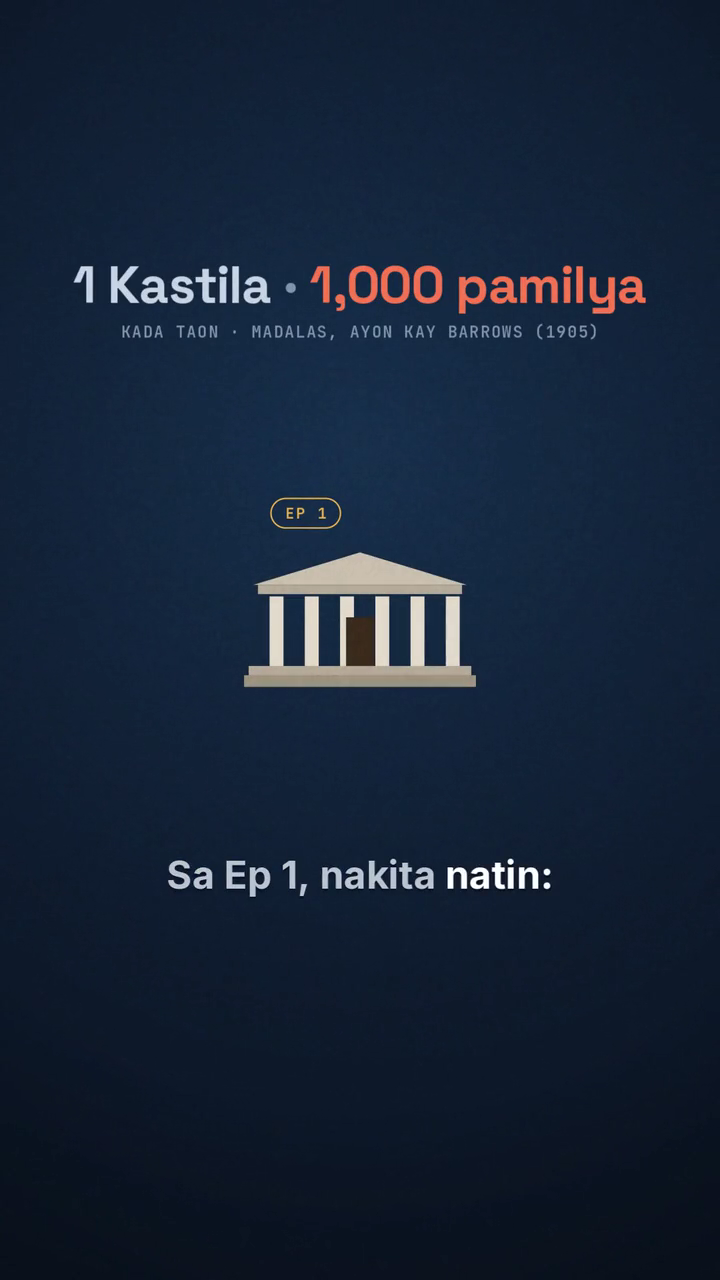
Four seconds into Episode 2, from Sai's cut: the headline over a recap of Episode 1.

6. What the numbers said

On 29 October I read Episode 1’s numbers: the biggest drop came 9 seconds in. Four more walks said Episode 2 should open on its claim and move the recap later. I parked that advice that morning because the recording was not ready, and Episode 2 went out with the recap first. On 11 November it had 473 plays at 9 days and a 14.5-second average watch. Episode 1 had 913 plays at 28 days and 16.9 seconds.

Episode 3, testing the opening before recording

Episode 3 starts from what Episode 2 taught: the opening decides who stays.
Six viewers, four openings
Round 1, 11 Nov, 8:35 am
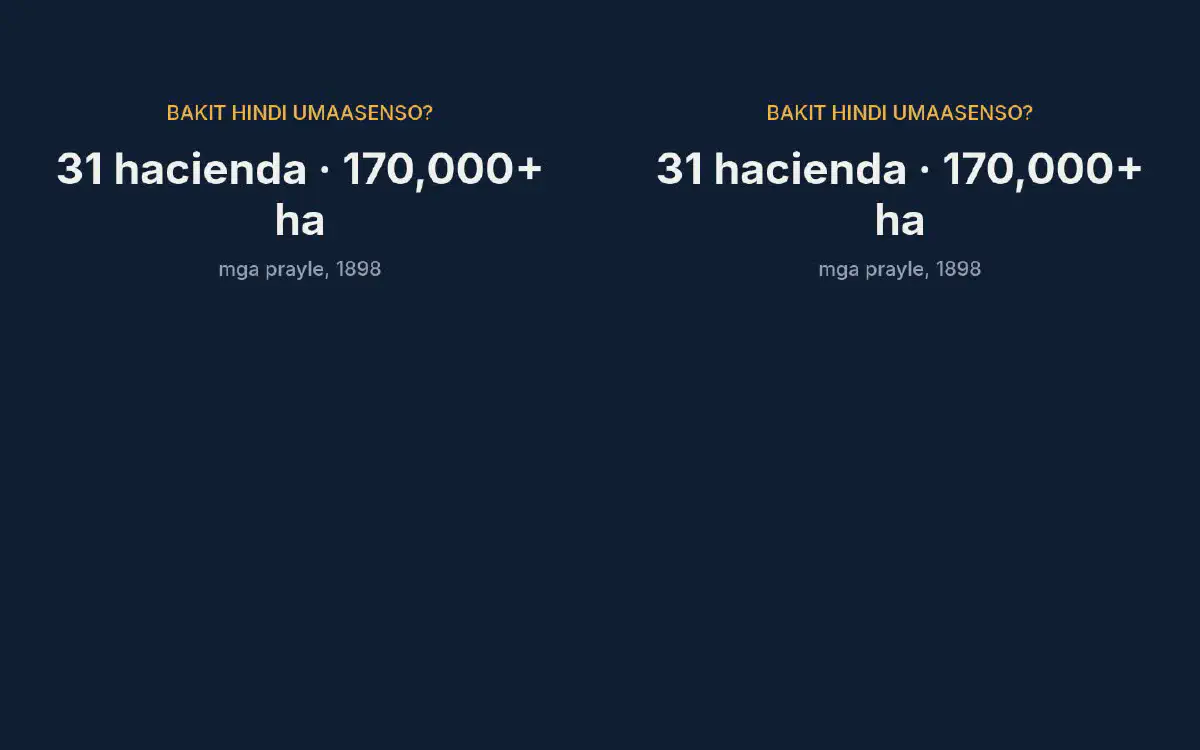
The panelSai's opening recaps Episode 2. It came last of seven, and every viewer swiped on the first words.
Sai's recap opening
Two frames of Sai's opening: a headline of 31 haciendas and 170,000 hectares on a plain dark card, captioned Sa Ep 2.
Man, 28, Quezon City, night shift 15% “'Sa Ep 2' agad, parang late ako sa usapan”
Woman, 31, Cebu City, sound off 15%
Man, 34, Davao, small business 18%
Man, 25, Laguna, follows the page 30% “feels like homework, not a story”
Woman, 26, Manila, sound off 8%
Man, 39, Bulacan, family farmed rented land 17% “feels like a class I missed”
On the real scale: 30.1%. Episode 1's real opening: 42.0%.
Round 2, 11 Nov, 8:59 am
MeAnatomy installation (we need to leverage this more)
Claude CodePut the land-office figure under the opening line as the first frame. Four of six read it as an ad.
The figure as frame one
Two frames: the question Bakit pinaalis ang pamilya ni Rizal over an isometric machine holding a small rice field.
Man, 28, Quezon City, night shift 43% “looks like a product ad”
Woman, 31, Cebu City, sound off 30% “parang tech ad, nalito ako”
Man, 34, Davao, small business 30%
Man, 25, Laguna, follows the page 42% “Looks like a tech product ad, not history”
Woman, 26, Manila, sound off 30%
Man, 39, Bulacan, family farmed rented land 38% “parang ad ng gadget, malayo sa buhay namin”
On the real scale: 34.6%. Episode 1's real opening: 42.0%.
Round 4, 11 Nov, 2:56 pm
MeRender the openings
Claude CodeRendered four openings as silent 10-second clips and ran the panel on the real frames. This one put a real document under a twist.
Rendered test B
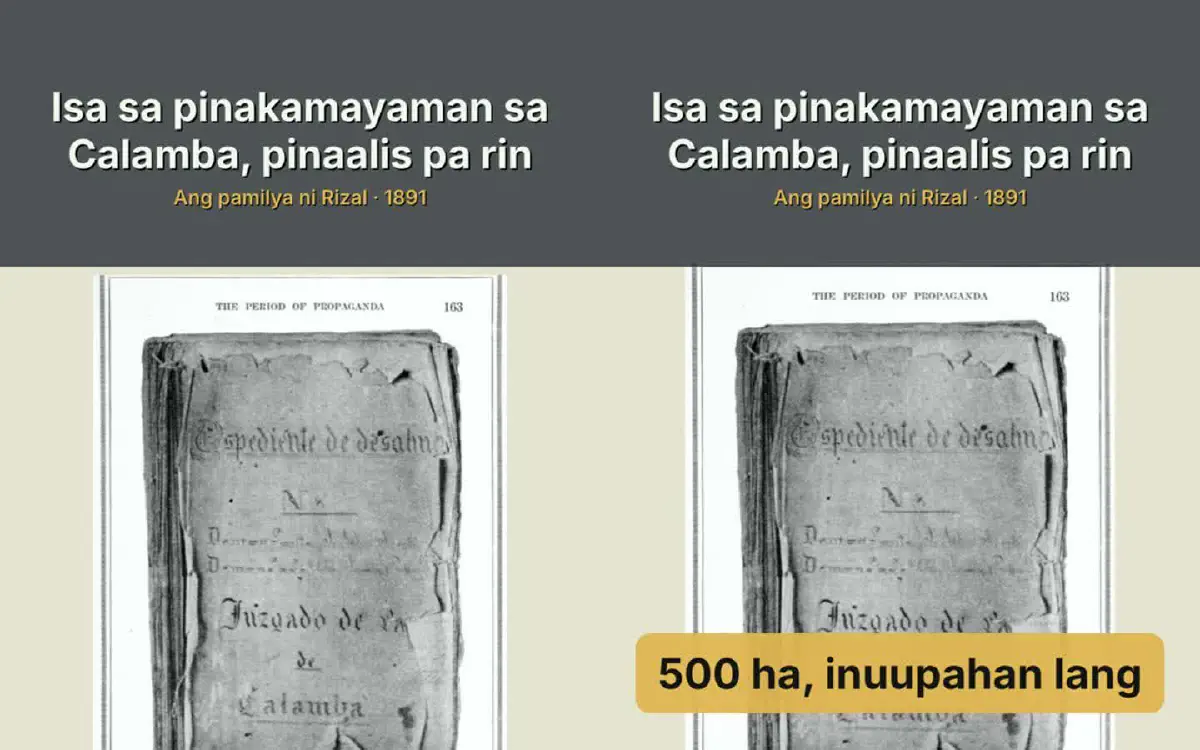
Two frames: Isa sa pinakamayaman sa Calamba, pinaalis pa rin, over a 1913 facsimile of a writ of eviction, then a label reading 500 ha, inuupahan lang.
Man, 28, Quezon City, night shift 48% “a twist I did not learn in school”
Woman, 31, Cebu City, sound off 30% “an old grey book page”
Man, 34, Davao, small business 50%
Man, 25, Laguna, follows the page 70% “gives me a puzzle and a number”
Woman, 26, Manila, sound off 38%
Man, 39, Bulacan, family farmed rented land 48% “lands close to home, since my family rented land too”
On the real scale: 41.5%. Episode 1's real opening: 42.0%.
Round 10, 12 Nov, 12:45 am
MeIf they don't understand us, we already lost
Claude CodeWrote four beats and six checks every opening must pass, then a fresh batch. This one asks whose name is on the land under your own house.
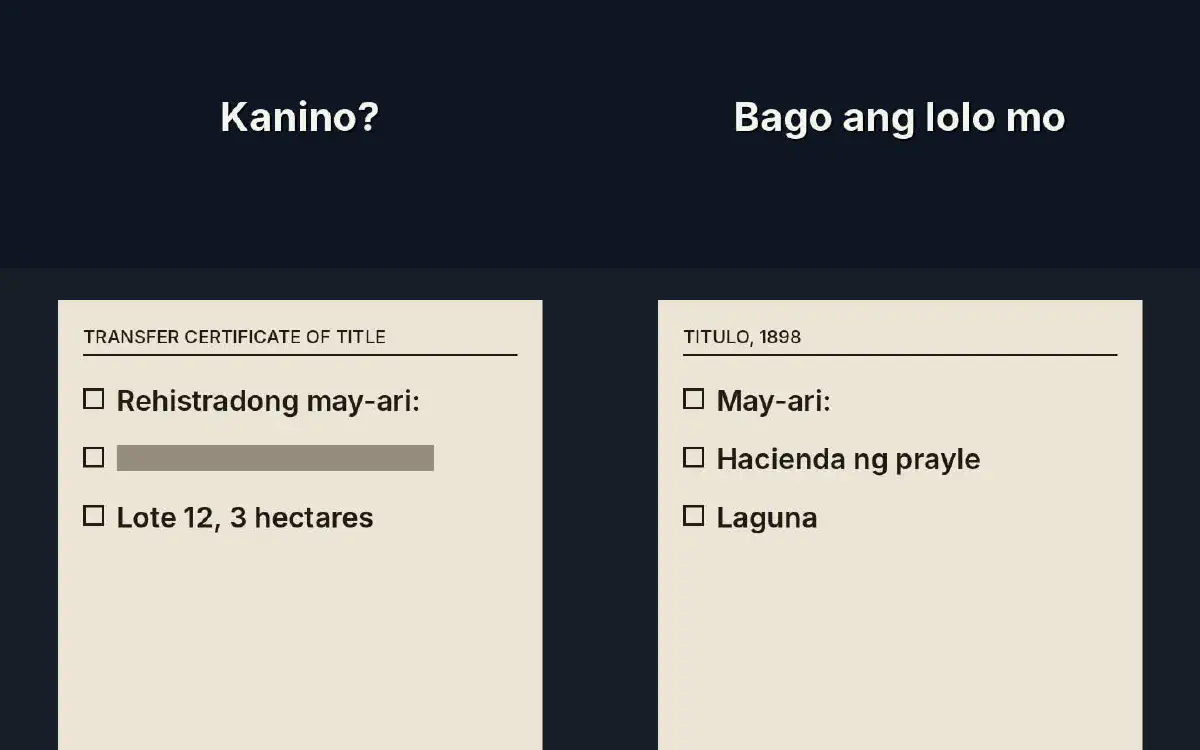
Titulo
Two frames: a land title with the owner's name blanked out under the word Kanino, then an 1898 title naming a friar hacienda in Laguna.
Man, 28, Quezon City, night shift 45% “kaba, curious”
Woman, 31, Cebu City, sound off 45% “170,000 ha, di ko ma-imagine gaano kalaki”
Man, 34, Davao, small business 50% “napaisip”
Man, 25, Laguna, follows the page 60%
Woman, 26, Manila, sound off 45%
Man, 39, Bulacan, family farmed rented land 65% “kirot”
On the real scale: 43.7%. Episode 1's real opening: 42.0%.
The six viewers are simulated: one Claude agent each, with a fixed profile, scoring every opening blind. Bars are each viewer's own chance of still watching at 3 seconds. Remarks are quoted from the panel's answer files of 11 and 12 November 2026.

1. A framework first

On 11 November at 4:54 am I said I would never reach an ending by picking between options, and asked for a framework. Eight agents studied the five channels I named and seven Filipino explainer creators. Twelve more turned that into a 13,000-word briefing. Its own machine checks failed on two of four counts, names and tone.

2. Where viewers leave

Claude pulled the page’s data and fitted a curve to each episode. About 58% of Episode 1’s plays and 68% of Episode 2’s ended before Facebook’s own graph begins. So the first three seconds became the thing to fix.

3. A panel of six

Six simulated viewers scored each opening blind. The real openings of Episode 1 and Episode 2 sat among the candidates, unlabelled, so the panel’s scores could be set against the real numbers. All six put Episode 1 above Episode 2, which matches the page. Sai’s recap opening came last.

4. The figure that lost

I wanted an Anatomy figure, a land office that turns village land into one owner’s title, as the first frame. Claude built it with 94 parts and proved it renders as video. The panel scored it 34.6%, and four of the six viewers read it as a gadget ad, so it moved inside the episode.
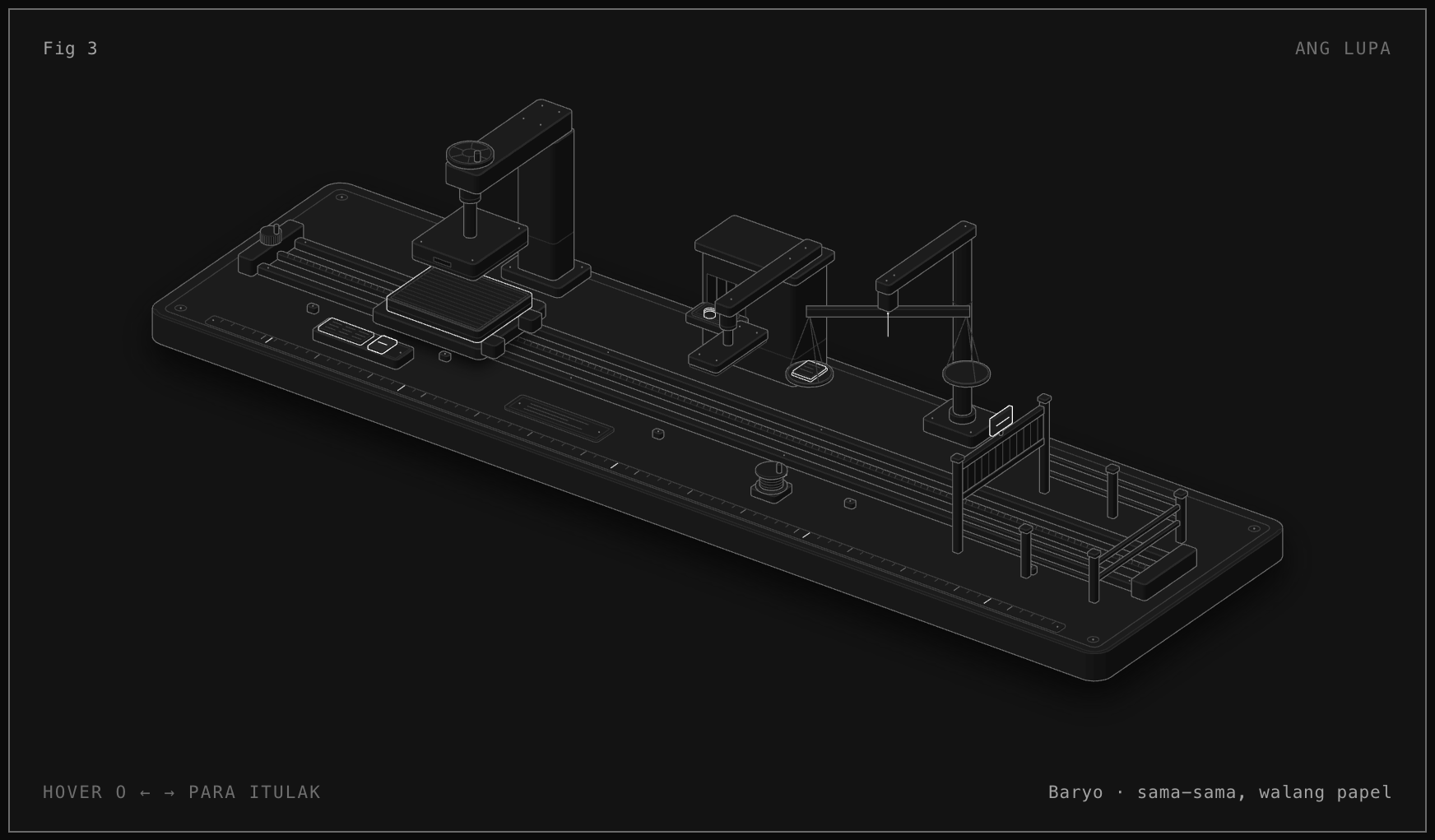
The land-office figure built for Episode 3 on 11 November 2026.

5. Four rendered openings

An audit of Sai’s script proposed 19 edits and I took each one. The new script has 44 lines. Four openings were rendered as silent 10-second clips. Claude caught that one of them put a line about friar estates over a photo of Hacienda Luisita, which was never a friar estate, and swapped the photo.

6. Undercooked

At 10:56 pm I called those openings undercooked. By 12:13 am I had the rule I was missing: if viewers do not understand us, we have already lost. That became four beats and six checks every opening must pass. Three more batches went to the panel that night. By 1:00 am on 12 November it had run 10 rounds, 60 viewer runs in all.

7. Where it stands

By that hour no opening had beaten Episode 1’s real 42% by more than the panel’s noise. The closest, “Titulo”, scored 40.7%, 43.7% and 39.9% in three rounds. The next step is a test on real viewers, with up to four openings, judged on views that last a minute.

The result

  • Episode 1 had 913 plays, 10 shares and 9 new followers at 28 days. Episode 2 had 473 plays at 9 days. The page had 22 followers when I read the numbers on 11 November 2026.
  • Six shorter reels cut from Episode 1 were rendered on 15 October and never posted.
  • The method now lives in a playbook Sai and I both work from: ten steps to make a video, with reading the numbers as the last one.
Email me the process you’d hand off first. In my working hours I reply within 30 minutes.
Email me ckwater123@gmail.com LinkedIn